
हिंदी

Potential and Potential Difference

Advertisements

Topics

Estimated time: 26 minutes
  • Introduction
  • Definition: Potential at a Point
  • Definition: Potential Difference
  • Formula: Electric Potential at a Point
  • Formula: Potential Difference
  • Key Points: Potential and Potential Difference
Maharashtra State Board: Class 11

Introduction

  • The concept of gravitational potential is derived from the gravitational potential energy of a system.
  • It isolates the factors that depend solely on the source mass (like Earth) and the specific location.
  • This value remains the same for any object placed at that specific point in the field.
  • It allows us to express potential energy simply as the product of potential and mass.
  • This concept is applicable to any conservative force field, not just gravity.
Maharashtra State Board: Class

Electrostatic Potential:

Water or liquids naturally flow from a higher level to a lower level, and heat transfers from a warmer object to a cooler one. In a similar way, positive electric charges move from a point with a higher electric level to a point with a lower electric level. This electric level, which governs the direction of charge flow, is referred to as electrostatic potential.

Electrostatic potential can be thought of as an "electric height" or level that drives the movement of electric charges, much like the height difference drives the flow of water. It is this difference in electrostatic potential between two points that causes charges to move, creating an electric current. This concept is fundamental to understanding how electricity flows in circuits.

Maharashtra State Board: Class 9

Potential Difference:

Electric charges flow in a circuit because of a potential difference, which is the difference in electrostatic potential between two points in the circuit. This potential difference acts as a driving force that causes electric charges to move, such as:

  • Water flows in a waterfall due to a difference in height.
  • Heat transfers from one object to another due to a difference in temperature.

Similarly, in an electric circuit, charges move from a point of higher potential to a point of lower potential. The potential difference ensures that the electric current flows, just as a height difference ensures the flow of water. Without a potential difference, there would be no movement of charges and thus no current in the circuit.

Potential difference of a cell:

  • The difference in potential between the positive and negative terminals of a cell is the potential difference of that cell. This potential difference is caused by chemical reactions occurring inside the cell.
  • The potential difference sets the electrons in motion and results in the flow of electricity through a conducting wire connected to the two ends of the cell.
  • The amount of work done to carry a unit positive charge from point A to point B is called the electric potential difference between the two points.

Potential difference between two points = `"Work"/" Total charge transferred"`, V = `"W"/"Q"`

1 V = `"1J"/"1C"` The unit of potential difference in SI system is volt.

Maharashtra State Board: Class 8

Experiment 1

1. Aim: To observe the flow of electric current in a circuit and understand the role of potential difference.

2. Requirements: copper connecting wires, a light bulb, and a 1.5 V dry cell (battery).

3. Procedure

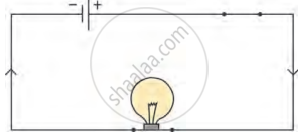
  • Build a circuit with copper wires and a light bulb as shown in Fig. a. The bulb does not light up because there is no current.
  • Connect a 1.5 V dry cell as in Fig. b. The bulb lights up, indicating current flow.
  • Electrons move from the negative to the positive terminal due to the potential difference created by the dry cell.
  • Conventional current flows in the opposite direction of electron movement.

(a) Electrical Circuit

 (b) Electrical Circuit

4. Conclusion: The bulb does not light up in the circuit without a cell because there is no potential difference to drive the current. When a cell is connected, a potential difference is applied, causing current to flow and the bulb to light up. The SI unit of potential difference is Volt (V), and the SI unit of electric current is Ampere (A), which is defined as 1 Coulomb of charge passing through a wire per second.

Maharashtra State Board: Class 11

Derivation

Derivation from Potential Energy

  • The gravitational potential energy (U) of a system containing Earth (mass M) and an object (mass m) at distance r is given by:
    U = -G\[\frac {Mm}{r}\]
  • We can rearrange this equation to separate the terms:
    U = \[\left( - \frac{GM}{r} \right)\]m
  • The term in the bracket \[\left( - \frac{GM}{r} \right)\] is identified as the Gravitational Potential (VE) of Earth.
  • This factor depends only on:
    The mass of the Earth (M).
    The location/distance from the center (r).

Relationship between Potential and Energy

Using the definition above, we can write the relationship as:
U = Vr × m

  • Where Vr is the gravitational potential at distance r.
  • Alternatively, \[V_r = \frac{U}{m}\].

Gravitational Potential Difference

  • The difference in potential between any two points in a gravitational field relates to the work done.
  • It is defined as the change in potential energy per unit mass or work done (dW) per unit mass.
    V2 − V1 = \[\frac{U_{2}-U_{1}}{m}\] = \[\frac {dW}{m}\]

General Case for Two Masses

For any two masses m1 and m2 separated by distance r, the potential energy can be interpreted in two ways:

  1. Potential of m1 at location r (V1) multiplied by mass m2.
  2. Potential of m2 at location $r$ (V2) multiplied by mass m1.
  • Formula:
    U = \[-G\frac{m_1m_2}{r}\] = (V1)m2 = (V2)m1

Maharashtra State Board: Class 9

Experiment 2

1. Aim: To observe the flow of water due to the difference in levels and relate it to the concept of electric potential.

2. Requirements: Two plastic bottles, a rubber tube, a clamp, and water.

3. Procedure

  • Set up the two bottles as shown in the figure.
  • Connect the bottles with a rubber tube.
  • Fill one bottle with water while keeping the other empty.
  • Use a clamp to stop water flow in the tube.
  • Remove the clamp and observe what happens.
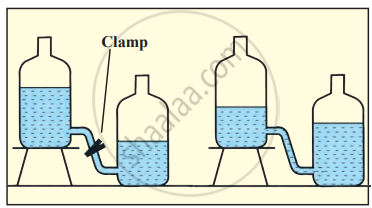
Level of water and direction of flow

4. Observations: When the clamp is removed, water flows from the bottle with a higher level to the one with a lower level. The flow stops when the water levels in both bottles become equal.

5. Conclusion: Water flows due to the difference in levels between the two bottles. Similarly, in electricity, the flow of electric charges depends on the electric potential difference between two points. Just as water stops flowing when levels are equal, electric charges stop moving when the potential difference becomes zero. To keep water (or electricity) flowing, a constant difference in level (or potential) must be maintained. This experiment demonstrates how a difference in levels (for water) or potential (for electricity) drives flow.

Maharashtra State Board: Class 9

Experiment 3

1. Aim: To demonstrate how a potential difference causes the flow of charges between two points.

2. Requirements: two conductors (A and B), a conducting wire, and insulated stands for safety.

3. Procedure

  • Place conductor A at a higher potential (positive charge) and conductor B at a lower potential (negative charge).
  • Connect the two conductors using a conducting wire.
  • Observe the flow of electrons from B (lower potential) to A (higher potential).

Potential difference and flow of electricity

4. Observation: Electrons flow from conductor B to conductor A because of the potential difference. The flow of electrons continues until the potential difference between A and B becomes zero.

5. Conclusion: A potential difference between two points drives the flow of charges. Positive charges move from higher to lower potential, while electrons (negative charges) move from lower to higher potential. Work is required to move a positive charge against the electric field, from lower to higher potential. This experiment explains how potential difference causes electric current in a circuit.

CISCE: Class 10

Definition: Potential at a Point

The potential at a point is defined as the amount of work done per unit charge in bringing a positive test charge from infinity to that point.

CBSE: Class 12
CISCE: Class 10

Definition: Potential Difference

The potential difference (p.d.) between two points is equal to the work done per unit charge in moving a positive test charge from one point to the other.

OR

The work done per unit positive charge in moving a charge from one point to another in an electric field, is called potential difference between those two points.

CISCE: Class 10

Formula: Electric Potential at a Point

V = \[\frac {W}{Q}\]

or

W = QV

CISCE: Class 10

Key points: Potential and Potential Difference

  • Electric potential is a scalar quantity, and it is positive near a positive charge and negative near a negative charge.
  • Electric potential is taken as zero at infinity because the force between charges becomes zero at infinite separation.
  • The potential difference between two points is measured using a voltmeter, which is connected in parallel with the circuit, with its positive terminal at the higher-potential point.

Test Yourself

Shaalaa.com | Electricity part 2 (Electric Potential difference)

Shaalaa.com


Next video


Shaalaa.com


Electricity part 2 (Electric Potential difference) [00:08:35]
S
Advertisements
Share
Notifications

Englishहिंदीमराठी


      Forgot password?
Use app×