Advertisements
Advertisements
प्रश्न
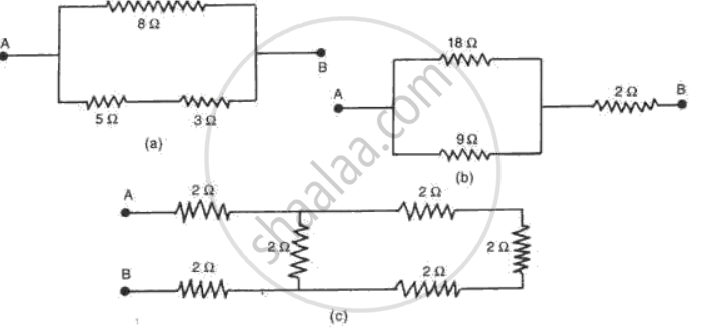
What is the combined resistance of each of the networks between A and B shown in fig. ?
Advertisements
उत्तर
(a) Between A andB,resistances 5Ω and 3 Ω are connected in series
·. Rs =5+3=8Ω
This series combination of resistances 5Ω and 3Ω is connected in parallel with the resistance 80
:. total resistance between A and Bis given as:
R = `[1/8 + 1/8]^-1` = 4Ω
(b) Bet ween A and B ,paralle combination of resistances 9Ω and 18Ω is connected in series with resistance 2Ω.
Parallel resistance of 9Ω and 18Ω is :
Rp = `[1/9 + 1/18]^-1` = 6Ω
:. total resistance between A and B is:
R=6+2=8Ω
(c) The situation consists of three two ohm resistors connected in series between CEFD and their combination in parallel with the fourth 2 ohm resistor between C and D.
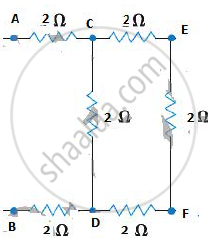
Therefore, series combination gives, 2 + 2 + 2 = 6 Ω.
This 6Ω resistor is connected in para lie I to the fourth 2Ω n resistor, therefore equivalent resistance between C and D,
`1/"R" = 1/6 + 1/2 = 2/3 Ω`
.·.R=l.5Ω
Now, between A and B the resistance Rand two 2Ω resistors are connected in series.
Therefore, equivalent resistance between A and B is
Rtotal = 2+2 +1.5 =5.5 Ω
APPEARS IN
संबंधित प्रश्न
Calculate the work done in moving a charge of 4 coulombs from a point at 220 volts to another point at 230 volts.
State whether a voltmeter has a high resistance of a low resistance. Give reason for your answer.
The other name of potential difference is:
A current of 5 amperes flows through a wire whose ends are at a potential difference of 3 volts. Calculate the resistance of the wire.
100 joules of heat is produced per second in a 4 ohm resistor. What is the potential difference across the resistor?
A current of 0.2 A flows through a conducting wire for 5 minutes. How much charge will flow?
State Ohm’s law.
A cylindrical conductor of length l and uniform area of cross section A has resistance R. Another conductor of length 2l and resistance R of the same material has area of cross section.
Name a device that helps to maintain a potential difference across conductors.
Study the following circuit and find:

- Effective resistance of the circuit
- Current drawn from the battery
- Potential difference across the 5 omega resistor
