Advertisements
Advertisements
प्रश्न
The figure shows a circuit. When the circuit is switched on, the ammeter reads 0.5 A.
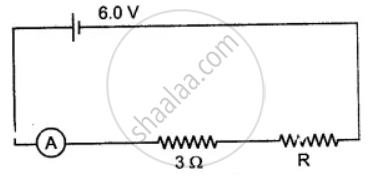
(i) Calculate the value of the unknown resistor R.
(ii) Calculate the charge passing through the 3 Ω resistor in 120 s.
(iii) Calculate the power dissipated in the 3 Ω resistor.
Advertisements
उत्तर
(i) We know, V = IR'
⇒ 6 = 0.5 × R'
⇒ R' = 12 Ohm
∵ R' = 3 + R
⇒ 12 = 3 + R
⇒ R = 9 Ohm
(ii) Charge, q = i t
⇒ q = 0.5 × 120 = 60 Coulomb
(iii) Power dissipation, p = i2R
p = 0.52 × 3 = 0.75 Watt
संबंधित प्रश्न
What is meant by saying that the potential difference between two points is 1 V?
How much energy is transferred by a 12 V Power supply to each coulomb of charge which it moves around a circuit?
The p.d. across a lamp is 12 V. How many joules of electrical energy are changed into heat and light when:
a charge of 1 C passes through it?
For the circuit shown in the diagram below:
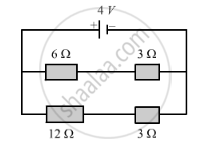
What is the value of:
(i) current through 6 Ω resistor?
(ii) potential difference across 12 Ω resistor?
What current will be taken by a 920 W appliance if the supply voltage is 230 V?
Three electric cells of potential difference 1.5 V each have been connected as a battery. The potential differences of the battery will be ____________ V.
Draw a graph of Potential difference (V) versus Current (I) for an ohmic resistor. How can you find the resistance of the resistor from this graph?
Suppose there are three resistors A, B, and C having resistances r1, r2, and r3 respectively. If R represents their equivalent resistance, establish the following relation `1/"R" = 1/"r"_1 + 1/"r"_2 + 1/"r"_3`, when joined in parallel.
Conceptual question.
A bird sitting on a high power electric line is still safe. How?
Two charged spherical conductors of radius R1 and R2 are connected by a wire. Then the ratio of surface charge densities of the spheres (σ1/σ2 ) is ______
