Advertisements
Advertisements
Question
The figure shows a circuit. When the circuit is switched on, the ammeter reads 0.5 A.
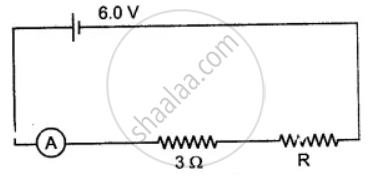
(i) Calculate the value of the unknown resistor R.
(ii) Calculate the charge passing through the 3 Ω resistor in 120 s.
(iii) Calculate the power dissipated in the 3 Ω resistor.
Advertisements
Solution
(i) We know, V = IR'
⇒ 6 = 0.5 × R'
⇒ R' = 12 Ohm
∵ R' = 3 + R
⇒ 12 = 3 + R
⇒ R = 9 Ohm
(ii) Charge, q = i t
⇒ q = 0.5 × 120 = 60 Coulomb
(iii) Power dissipation, p = i2R
p = 0.52 × 3 = 0.75 Watt
RELATED QUESTIONS
A battery of emf 12 V and internal resistance 2 Ω is connected with two resistors A and B of resistance 4 Ω and 6 Ω respectively joined in series.
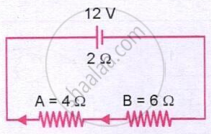
Find:
- Current in the circuit.
- The terminal voltage of the cell.
- The potential difference across 6Ω Resistor.
- Electrical energy spent per minute in the 4Ω resistor.
b. The values of potential difference V applied across a resistor and the correponding values of current I flowing in the resistor are given below:
| Potential difference, V (in volts) | : | 2.5 | 5.0 | 10.0 | 15.0 | 20.0 | 25.0 |
| Current, I (in amperes) | : | 0.1 | 0.2 | 0.4 | 0.6 | 0.8 | 1.0 |
Plot a graph between V and I, and calculate the resistance of the resistor.
c. Name the law which is illustrated by the above V-I graph.
State the S.I. unit of electric potential.
How is the electric potential difference between the two points defined? State its S.I. unit.
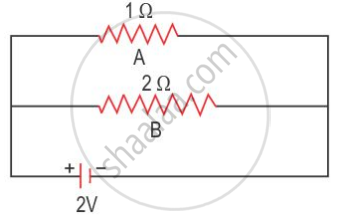
Calculate the current flowing through each of the resistors A and B in the circuit shown in the following figure.
Find the resistance of a conductor if the electric current flowing through it is 0.35 A when the potential difference across it is 1.4 V.
Assertion (A): Charges flow from higher potential to lower potential.
Reason (R): Current flows mainly due to the flow of electrons.
Name a device that helps to maintain a potential difference across conductors.
Inside a hollow charged spherical conductor, the potential ______
