Advertisements
Advertisements
Question
A current of 100 mA. flows through a wire. The charge on an electron is 1.6 × 10⁻¹⁹ C. Find the number of electrons passing per second through the cross-section of the conductor.
Advertisements
Solution
Given: I = 100mA = 100 × 10-3 A = 0.1A, e = 1.6 × 10⁻¹⁹ C
Let n electrons are passing per second. Charge on one electron = e
Total charge passed in one second = ne
Thus, i = ne or
n = `"i"/"e" = 0.1/(1.6 xx 10^-19) = 6.25 xx 10^17`.
RELATED QUESTIONS
What is meant by saying that the potential difference between two points is 1 V?
Ohm's law state a relation between potential difference and ___________.
Write down the formula which states the relation between potential difference, current, and resistance.
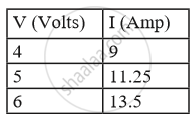
The following table shows current in Amperes and potential difference in Volts.
What will be the nature of the graph between the current and potential difference? (Do not draw a graph.)
State whether the potential is a scalar or vector?
From the following observations taken while determining the resistance of a conductor, draw the current-voltage graph and calculate the resistance of conductor. Is the conductor ohmic?
| Ammeter reading I (in ampere) | Voltmeter reading V (in volt) |
| 0.2 | 0.4 |
| 0.3 | 0.6 |
| 0.5 | 1.0 |
| 0.8 | 1.6 |
| 1.5 | 3.0 |
A current of 0.2 A flows through a conducting wire for 5 minutes. How much charge will flow?
State Ohm’s law.
An electric charge always flows from a point at a ______ to a point at a ______.
Twenty-seven drops of the same size are charged at 220 V each. They combine to form a bigger drop. Calculate the potential of the bigger drop.
