Advertisements
Advertisements
Question
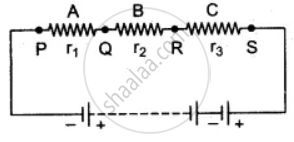
Suppose there are three resistors A, B, and C having resistances r1, r2, and r3 respectively. If R represents their equivalent resistance, establish the following relation R = r1 + r2 + r3 when joined in series.
Advertisements
Solution
Let the three resistors be joined in series in given figure.
Let potential at P, Q, R and S are Vp, VQ, VR, and VS respectively and current i flows in the circuit.
Applying Ohm's law,
Vp + VQ = ir1 ...(i)
VQ - VR = ir2 ....(ii)
and VR - VS = ir3 ....(iii)
If the total effective resistance between P and S be R', then the potential difference:
VP - VR = iR' ....(A)
Adding (i), (ii) and (iii)
VP - VQ + VQ - VR + VR - VS = ir1 + ir2 + ir3
or VP - VS = i (r1 + r2 + r3) .... (B)
Comparing (A) and (B), we get
iR' = i (r1 + r2 + r3)
or R' = r1 + r2 + r3
RELATED QUESTIONS
What is the SI unit of potential difference?
What do you understand by the term "electric potential"? (or potential) at a point? What is the unit of electric potential?
Define the term ‘volt’.
Electric cells having 2V potential difference each have been connected in the form of a battery. What will be the total potential difference of the battery in both cases?


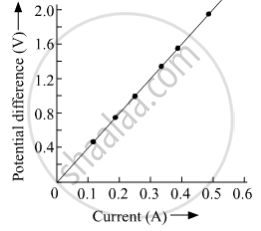
A V-I graph for a nichrome wire is given below. What do you infer from this graph? Draw a labelled circuit diagram to obtain such a graph.
A battery of 10 volt carries 20,000 C of charge through a resistance of 20 Ω. The work done in 10 seconds is:
Electric potential is a ____________.
A current of 1 ampere flows in a series circuit containing an electric lamp and a conductor of 5 Ω when connected to a 10 V battery. Calculate the resistance of the electric lamp.
Now if a resistance of 10 Ω is connected in parallel with this series combination, what change (if any) in current flowing through 5 Ω conductor and potential difference across the lamp will take place? Give reason.
An electric charge always flows from a point at a ______ to a point at a ______.
Twenty-seven drops of same size are charged at 220 V each. They combine to form a bigger drop. Calculate the potential of the bigger drop.
