Advertisements
Advertisements
Question
Three resistors are connected to a 12 V battery as shown in the figure given below:
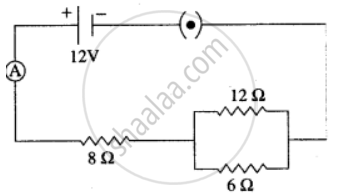
(i) What is the current through the 8 ohm resistor?
(ii) What is the potential difference across the parallel combination of 6 ohm and 12 ohm resistor?
(iii) What is the current through the 6 ohm resistor?
Advertisements
Solution
(i) 6 ohm and 12 ohm are connected in parallel, So
⇒ `1/"R"_1 = 1/6 + 1/12 = (2 + 1)/12 = 3/12`
⇒ `1/"R"_1 = 1/4`
R1 = 4 ohm.
∴ Total Resistance R = 8 + 4 = 12 ohm.
Now ∵ V = IR
⇒ 12 = I × 12
∴ I = 1 Amp.
(ii) V = IR = 1 ×4 = 4 Volt
(iii) ∵ V = I1R
⇒ 4 = I1 × 6
∴ I1 = `4/6`
= 0.66 Amp.
RELATED QUESTIONS
State the relation between potential difference, work done and charge moved.
What is a voltmeter?
State whether a voltmeter has a high resistance of a low resistance. Give reason for your answer.
Keeping the potential difference constant, the resistance of a circuit is halved. By how much does the current change?
What is Ohm's law? Explain how it is used to define the unit of resistance.
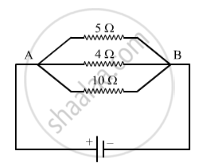
In the circuit diagram given below, the current flowing across 5 ohm resistor is 1 amp. Find the current flowing through the other two resistors.
100 joules of heat is produced per second in a 4 ohm resistor. What is the potential difference across the resistor?
How is the electric potential difference between the two points defined? State its S.I. unit.
A current of 0.2 A flows through a wire whose ends are at a potential difference of 15 V. Calculate:
(i) The resistance of the wire, and
(ii) The heat energy produced in 1 minute.
Which of the following represents voltage?
