Advertisements
Advertisements
प्रश्न
Three resistors are connected to a 12 V battery as shown in the figure given below:
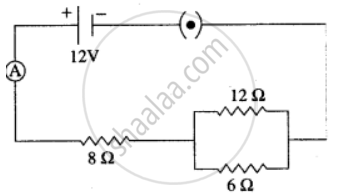
(i) What is the current through the 8 ohm resistor?
(ii) What is the potential difference across the parallel combination of 6 ohm and 12 ohm resistor?
(iii) What is the current through the 6 ohm resistor?
Advertisements
उत्तर
(i) 6 ohm and 12 ohm are connected in parallel, So
⇒ `1/"R"_1 = 1/6 + 1/12 = (2 + 1)/12 = 3/12`
⇒ `1/"R"_1 = 1/4`
R1 = 4 ohm.
∴ Total Resistance R = 8 + 4 = 12 ohm.
Now ∵ V = IR
⇒ 12 = I × 12
∴ I = 1 Amp.
(ii) V = IR = 1 ×4 = 4 Volt
(iii) ∵ V = I1R
⇒ 4 = I1 × 6
∴ I1 = `4/6`
= 0.66 Amp.
संबंधित प्रश्न
State two causes of energy loss in a transformer.
State whether a voltmeter has a high resistance of a low resistance. Give reason for your answer.
A current of 5 amperes flows through a wire whose ends are at a potential difference of 3 volts. Calculate the resistance of the wire.
Keeping the potential difference constant, the resistance of a circuit is doubled. By how much does the current change?
The potential difference between the terminals of an electric iron is 240 V and the current is 5.0 A. What is the resistance of the electric iron?
Conceptual question.
A bird sitting on a high power electric line is still safe. How?
Exercise.
Calculate the amount of charge that would flow in 2 hours through an element of an electric bulb drawing a current of 2.5 A.
If P and V are the power and potential of device, the power consumed with a supply potential V1 is:
______ is work done per unit charge.
