Advertisements
Advertisements
प्रश्न
Three resistors are connected to a 12 V battery as shown in the figure given below:
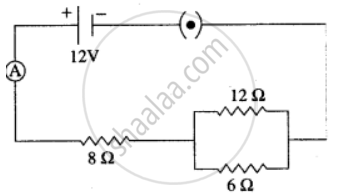
(i) What is the current through the 8 ohm resistor?
(ii) What is the potential difference across the parallel combination of 6 ohm and 12 ohm resistor?
(iii) What is the current through the 6 ohm resistor?
Advertisements
उत्तर
(i) 6 ohm and 12 ohm are connected in parallel, So
⇒ `1/"R"_1 = 1/6 + 1/12 = (2 + 1)/12 = 3/12`
⇒ `1/"R"_1 = 1/4`
R1 = 4 ohm.
∴ Total Resistance R = 8 + 4 = 12 ohm.
Now ∵ V = IR
⇒ 12 = I × 12
∴ I = 1 Amp.
(ii) V = IR = 1 ×4 = 4 Volt
(iii) ∵ V = I1R
⇒ 4 = I1 × 6
∴ I1 = `4/6`
= 0.66 Amp.
संबंधित प्रश्न
You have three resistors of values 2Ω, 3Ω and 5Ω. How will you join them so that the total resistance is more than 7Ω?
1) Draw a diagram for the arrangement
2) Calculate the equivalent resistance.
Calculate the work done in moving a charge of 4 coulombs from a point at 220 volts to another point at 230 volts.
Name the law which relates the current in a conductor to the potential difference across its ends.
Why do electricians wear rubber hand gloves while working with electricity?
What is the ratio of potential difference and current known as?
Draw a graph of Potential difference (V) versus Current (I) for an ohmic resistor. How can you find the resistance of the resistor from this graph?
A current of 0.2 A flows through a conducting wire for 5 minutes. How much charge will flow?
If P and V are the power and potential of device, the power consumed with a supply potential V1 is:
The SI unit of potential difference is ______.
Two charged spherical conductors of radius R1 and R2 are connected by a wire. Then the ratio of surface charge densities of the spheres (σ1/σ2 ) is ______
