Advertisements
Advertisements
प्रश्न
You have three resistors of values 2Ω, 3Ω and 5Ω. How will you join them so that the total resistance is more than 7Ω?
1) Draw a diagram for the arrangement
2) Calculate the equivalent resistance.
Advertisements
उत्तर
To get total resistance more than 7Ω. We can connect 2Ω,3Ω and 5Ω in series.
1)

2)
`R_"equivalent"` = 2 + 3 + 5 = 10Ω
APPEARS IN
संबंधित प्रश्न
What is meant by saying that the potential difference between two points is 1 V?
Potential difference is measured in _________ by using a ___________ placed in ___________ across a component.
Keeping the potential difference constant, the resistance of a circuit is halved. By how much does the current change?
What is Ohm's law? Explain how it is used to define the unit of resistance.
Define the term ‘volt’.
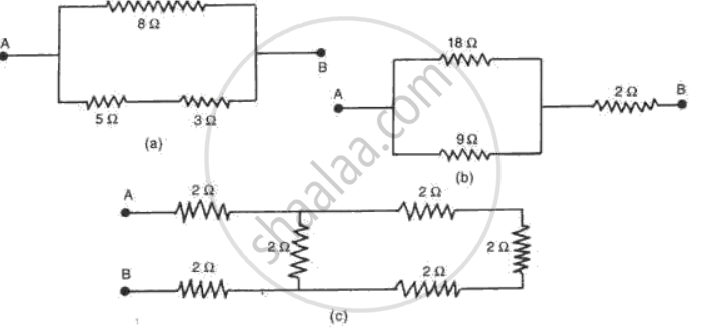
What is the combined resistance of each of the networks between A and B shown in fig. ?
What would you suggest to a student if while performing an experiment he finds that the pointer/needle of the ammeter and voltmeter do not coincide with the zero marks on the scales when the circuit is open? No extra ammeter/voltmeter is available in the laboratory.
Which of the following represents voltage?
How will you conclude that the same potential difference (voltage) exists across three resistors connected in a parallel arrangement to a battery?
An electric charge always flows from a point at a ______ to a point at a ______.
