Advertisements
Advertisements
प्रश्न
You have three resistors of values 2Ω, 3Ω and 5Ω. How will you join them so that the total resistance is more than 7Ω?
1) Draw a diagram for the arrangement
2) Calculate the equivalent resistance.
Advertisements
उत्तर
To get total resistance more than 7Ω. We can connect 2Ω,3Ω and 5Ω in series.
1)

2)
`R_"equivalent"` = 2 + 3 + 5 = 10Ω
APPEARS IN
संबंधित प्रश्न
What do the letters p.d. stand for?
The other name of potential difference is:
b. The values of potential difference V applied across a resistor and the correponding values of current I flowing in the resistor are given below:
| Potential difference, V (in volts) | : | 2.5 | 5.0 | 10.0 | 15.0 | 20.0 | 25.0 |
| Current, I (in amperes) | : | 0.1 | 0.2 | 0.4 | 0.6 | 0.8 | 1.0 |
Plot a graph between V and I, and calculate the resistance of the resistor.
c. Name the law which is illustrated by the above V-I graph.
Write proper word from the following group of words in the blank.
(magnetism, 4.5V, 3.0V, gravitational attraction, potential difference, potential, higher, lower, 0V)
Water in the waterfall flows from a higher level to the lower level because of ______.
Explain why potential difference is always less than the e.m.f. of a cell?
Five resistors of different resistances are connected together as shown in the figure. A 12 V battery is connected to the arrangement.
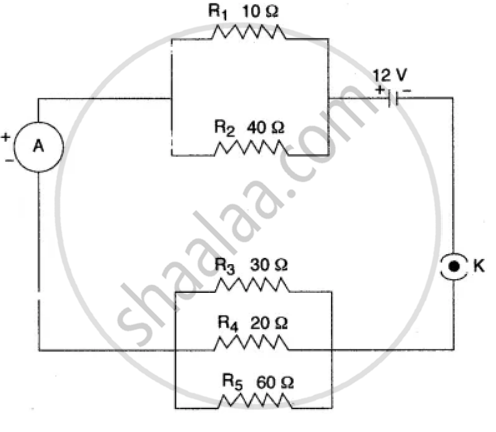
Calculate:
(i) the total resistance in the circuit
(ii) the total current flowing in the circuit.
In the figure given below, A, B and C are three ammeters. The ammeter B reads 0.5A. (All the ammeters have negligible resistance.)
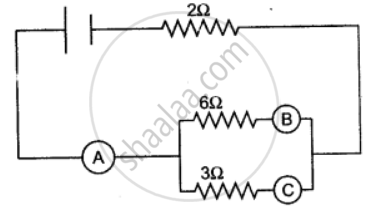
Calculate:
(i) the readings in the ammeters A and C.
(ii) the total resistance of the circuit.
Conceptual question.
Does a solar cell always maintain the potential across its terminals constant? Discuss
Define electric potential and potential difference.
An electric charge always flows from a point at a ______ to a point at a ______.
