Advertisements
Advertisements
प्रश्न
Conceptual question.
Does a solar cell always maintain the potential across its terminals constant? Discuss
Advertisements
उत्तर
A solar cell does not always maintain a constant potential difference across its terminals.
Its voltage depends on the intensity of sunlight, temperature, and the load connected to it. In strong light and with a light load, the terminal voltage is high. When the light intensity decreases or when a heavy load is connected, the voltage drops. Thus, unlike a battery, a solar cell cannot maintain a constant potential difference under all conditions.
APPEARS IN
संबंधित प्रश्न
You have three resistors of values 2Ω, 3Ω and 5Ω. How will you join them so that the total resistance is more than 7Ω?
1) Draw a diagram for the arrangement
2) Calculate the equivalent resistance.
How is a voltmeter connected in the circuit to measure the potential difference between two points? Explain with the help of a diagram.
A current of 5 amperes flows through a wire whose ends are at a potential difference of 3 volts. Calculate the resistance of the wire.
Calculate the power used in the 2 Ω resistor in each of the following circuits: a 6 V battery in series with 1 Ω and 2 Ω resistors.
Electric cells having 2V potential difference each have been connected in the form of a battery. What will be the total potential difference of the battery in both cases?


What would you suggest to a student if while performing an experiment he finds that the pointer/needle of the ammeter and voltmeter do not coincide with the zero marks on the scales when the circuit is open? No extra ammeter/voltmeter is available in the laboratory.
In the figure given below, A, B and C are three ammeters. The ammeter B reads 0.5A. (All the ammeters have negligible resistance.)
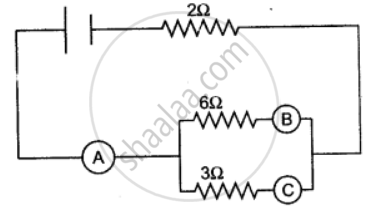
Calculate:
(i) the readings in the ammeters A and C.
(ii) the total resistance of the circuit.
How will you conclude that the same potential difference (voltage) exists across three resistors connected in a parallel arrangement to a battery?
Find out the following in the electric circuit given in Figure
- Effective resistance of two 8 Ω resistors in the combination
- Current flowing through 4 Ω resistor
- Potential difference across 4 Ω resistance
- Power dissipated in 4 Ω resistor
- Difference in ammeter readings, if any.

Name a device that helps to maintain a potential difference across conductors.
