Advertisements
Advertisements
प्रश्न
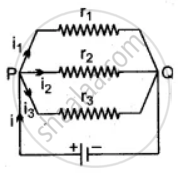
Suppose there are three resistors A, B, and C having resistances r1, r2, and r3 respectively. If R represents their equivalent resistance, establish the following relation `1/"R" = 1/"r"_1 + 1/"r"_2 + 1/"r"_3`, when joined in parallel.
Advertisements
उत्तर
When joined in parallel, let the main current be i which sub-divides at P into i1 in r1, i2 in r2 and i3 in r3 respectively in given figure.
If potential difference across PQ be V then,
According to Ohm's law:
i1 = Vr1 ...(i)
i2 = Vr2 ....(ii)
and i3 = Vr3 ...(iii)
If R'' be the equivalent resistance of this combination, then
i = `"V"/"R''"` ....(A)
From (i), (ii) and (iii) on adding, we get ....(B)
i = i1 + i2 + i3
`= "V"/"r"_1 + "V"/"r"_2 + "V"/"r"_3`
`= "V"(1/"r"_1 + 1/"r"_2 + 1/"r"_3)`
Comparing (A) and (B)
`"V"/"R''" = "V"(1/"r"_1 + 1/"r"_2 + 1/"r"_3)`
or `1/"R''" = 1/"r"_1 + 1/"r"_2 + 1/"r"_3`
संबंधित प्रश्न
Potential difference is measured in _________ by using a ___________ placed in ___________ across a component.
The p.d. across a lamp is 12 V. How many joules of electrical energy are changed into heat and light when: a current of 2 A flows through it for 10 s?
What is Ohm's law? Explain how it is used to define the unit of resistance.
Why do electricians wear rubber hand gloves while working with electricity?
How does the resistance of a metallic wire depend on its temperature? Explain with reason.
Write an expression for the electrical power spent in flow of current through a conductor in terms of current and resistance.
Find the resistance of a conductor if the electric current flowing through it is 0.35 A when the potential difference across it is 1.4 V.
The SI unit of potential difference is ______.
Find the potential difference required to flow a current of 300 mA in a wire of resistance 20 Ω.
