Advertisements
Advertisements
प्रश्न
The V-I graph for a series combination and for a parallel combination of two resistors is shown in Fig – 8.38. Which of the two, A or B, represents the parallel combination? Give a reason for your answer.
Advertisements
उत्तर
For the same change in I, change in V is less for the straight line A than for the straight line B (i.e., the straight line A is less steeper than B), so the straight line A represents small resistance, while the straight line B represents more resistance. In parallel combination, the resistance decreases while in series combination, the resistance increases. So A represents the parallel combination.
संबंधित प्रश्न
What is meant by saying that the electric potential at a point is 1 volt?
What is the potential difference between the terminals of a battery if 250 joules of work is required to transfer 20 coulombs of charge from one terminal of battery to the other?
Keeping the resistance constant, the potential difference applied across the ends of a component is halved. By how much does the current change?
Why do electricians wear rubber hand gloves while working with electricity?
Explain the statement ‘the potential difference between two points is 1 volt’.
Write proper word from the following group of words in the blank.
(magnetism, 4.5V, 3.0V, gravitational attraction, potential difference, potential, higher, lower, 0V)
Water in the waterfall flows from a higher level to the lower level because of ______.
The figure shows a circuit. When the circuit is switched on, the ammeter reads 0.5 A.
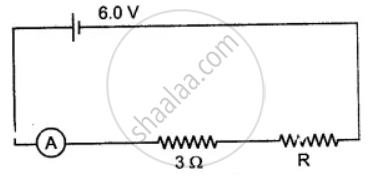
(i) Calculate the value of the unknown resistor R.
(ii) Calculate the charge passing through the 3 Ω resistor in 120 s.
(iii) Calculate the power dissipated in the 3 Ω resistor.
100 J of heat is produced each second in a 4 Ω resistor. The potential difference across the resistor will be:
How will you conclude that the same potential difference (voltage) exists across three resistors connected in a parallel arrangement to a battery?
Twenty-seven drops of same size are charged at 220 V each. They combine to form a bigger drop. Calculate the potential of the bigger drop.
