Advertisements
Advertisements
प्रश्न
How is the electric potential difference between the two points defined? State its S.I. unit.
Advertisements
उत्तर
The potential difference between two points is equal to the work done in moving a unit positive charge from one point to the other.
It's S.I. unit is Volt.
APPEARS IN
संबंधित प्रश्न
What is meant by saying that the potential difference between two points is 1 V?
Which device is used to measure p.d?
Potential difference is measured in _________ by using a ___________ placed in ___________ across a component.
The unit for measuring potential difference is ______.
Three resistors are connected to a 12 V battery as shown in the figure given below:
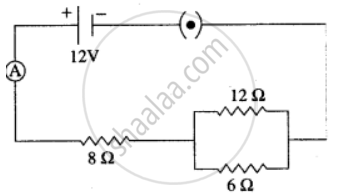
(i) What is the current through the 8 ohm resistor?
(ii) What is the potential difference across the parallel combination of 6 ohm and 12 ohm resistor?
(iii) What is the current through the 6 ohm resistor?
Five resistors of different resistances are connected together as shown in the figure. A 12 V battery is connected to the arrangement.
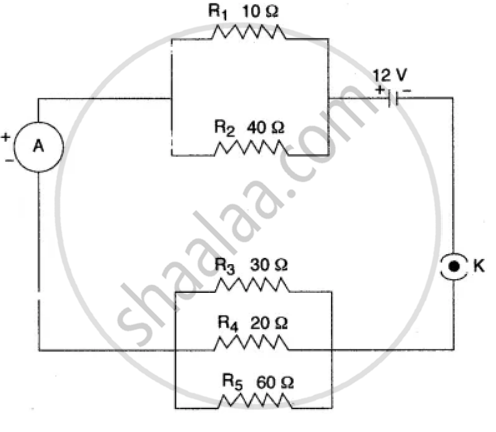
Calculate:
(i) the total resistance in the circuit
(ii) the total current flowing in the circuit.
A 10 m long wire of a particular material is of resistance 5Ω What will be the resistance if the wire is doubled itself.
A boy records that 4000 joules of work are required to transfer 10 coulombs of charge between two points of a resistor of 50 Ω. The current passing through it is:
A current of 1 ampere flows in a series circuit containing an electric lamp and a conductor of 5 Ω when connected to a 10 V battery. Calculate the resistance of the electric lamp.
Now if a resistance of 10 Ω is connected in parallel with this series combination, what change (if any) in current flowing through 5 Ω conductor and potential difference across the lamp will take place? Give reason.
Find out the following in the electric circuit given in Figure
- Effective resistance of two 8 Ω resistors in the combination
- Current flowing through 4 Ω resistor
- Potential difference across 4 Ω resistance
- Power dissipated in 4 Ω resistor
- Difference in ammeter readings, if any.

