Advertisements
Advertisements
Question
How is the electric potential difference between the two points defined? State its S.I. unit.
Advertisements
Solution
The potential difference between two points is equal to the work done in moving a unit positive charge from one point to the other.
It's S.I. unit is Volt.
APPEARS IN
RELATED QUESTIONS
Calculate the quantity of heat produced in a 20 Ω resistor carrying 2.5 A current in 5 minutes.
What is the SI unit of potential difference?
Define the unit of resistance (or Define the unit "ohm").
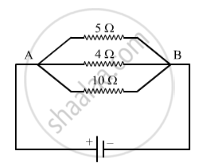
In the circuit diagram given below, the current flowing across 5 ohm resistor is 1 amp. Find the current flowing through the other two resistors.
The device used for measuring potential difference is
What would you suggest to a student if while performing an experiment he finds that the pointer/needle of the ammeter and voltmeter do not coincide with the zero marks on the scales when the circuit is open? No extra ammeter/voltmeter is available in the laboratory.
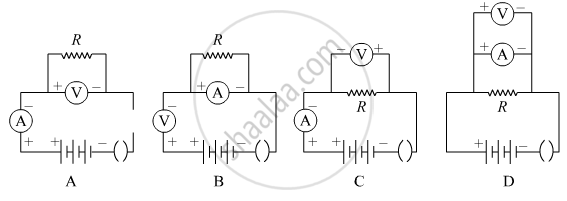
Which one of the following is the correct set-up for studying the dependence of the current on the potential difference across a resistor and why?
Draw a graph of Potential difference (V) versus Current (I) for an ohmic resistor. How can you find the resistance of the resistor from this graph?
If P and V are the power and potential of device, the power consumed with a supply potential V1 is:
Two charged spherical conductors of radius R1 and R2 are connected by a wire. Then the ratio of surface charge densities of the spheres (σ1/σ2 ) is ______
