Advertisements
Advertisements
प्रश्न
How is the electric potential difference between the two points defined? State its S.I. unit.
Advertisements
उत्तर
The potential difference between two points is equal to the work done in moving a unit positive charge from one point to the other.
It's S.I. unit is Volt.
APPEARS IN
संबंधित प्रश्न
Name a device that helps to maintain a potential difference across a conductor.
State two causes of energy loss in a transformer.
What do the letters p.d. stand for?
A current of 5 amperes flows through a wire whose ends are at a potential difference of 3 volts. Calculate the resistance of the wire.
A current of 1.6 mA flows through a conductor. If charge on an electron is –1.6 × 10⁻¹⁹ coulomb, find the number of electrons that will pass each second through the cross section of that conductor.
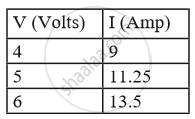
The following table shows current in Amperes and potential difference in Volts.
Which law will the graph prove? Explain the law.
Define the following:
Potential difference
Define Electric potential.
Twenty-seven drops of the same size are charged at 220 V each. They combine to form a bigger drop. Calculate the potential of the bigger drop.
What does the positive and negative sign of potential convey?
