Advertisements
Advertisements
प्रश्न
Explain the statement ‘the potential difference between two points is 1 volt’.
Advertisements
उत्तर
One volt is the potential difference between two points in an electric circuit when 1 joule of work is done to move a charge of 1 coulomb from one point to another.
1 volt = `(1 "Joule")/(1 "Coloumb")`
APPEARS IN
संबंधित प्रश्न
Name a device that helps to maintain a potential difference across a conductor.
What do the letters p.d. stand for?
Define one coulomb charge.
Name the law which relates the current in a conductor to the potential difference across its ends.
Keeping the potential difference constant, the resistance of a circuit is halved. By how much does the current change?
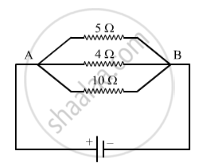
In the circuit diagram given below, the current flowing across 5 ohm resistor is 1 amp. Find the current flowing through the other two resistors.
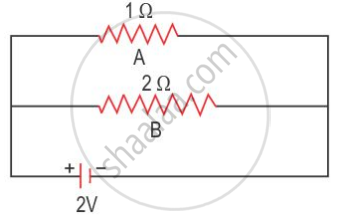
Calculate the current flowing through each of the resistors A and B in the circuit shown in the following figure.
Three resistors are connected to a 12 V battery as shown in the figure given below:
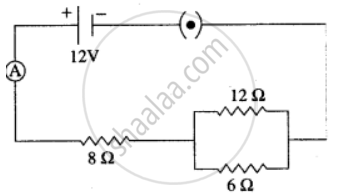
(i) What is the current through the 8 ohm resistor?
(ii) What is the potential difference across the parallel combination of 6 ohm and 12 ohm resistor?
(iii) What is the current through the 6 ohm resistor?
Suppose there are three resistors A, B, and C having resistances r1, r2, and r3 respectively. If R represents their equivalent resistance, establish the following relation R = r1 + r2 + r3 when joined in series.
Conceptual question.
A bird sitting on a high power electric line is still safe. How?
