Advertisements
Advertisements
प्रश्न
Explain the statement ‘the potential difference between two points is 1 volt’.
Advertisements
उत्तर
One volt is the potential difference between two points in an electric circuit when 1 joule of work is done to move a charge of 1 coulomb from one point to another.
1 volt = `(1 "Joule")/(1 "Coloumb")`
APPEARS IN
संबंधित प्रश्न
A battery of emf 12 V and internal resistance 2 Ω is connected with two resistors A and B of resistance 4 Ω and 6 Ω respectively joined in series.
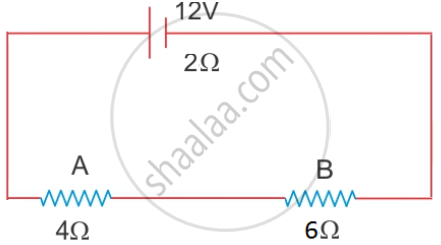
Find:
1) Current in the circuit
2) The terminal voltage of the cell
3) The potential difference across 6Ω Resistor
4) Electrical energy spent per minute in the 4Ω resistor.
By what other name is the unit joule/coulomb called?
Which of the following statements correctly defines a volt?
(a) a volt is a joule per ampere.
(b) a volt is a joule per coulomb.
What is the unit of electric charge?
State the relation between potential difference, work done and charge moved.
What p.d. is needed to send a current of 6 A through an electrical appliance having a resistance of 40 Ω?
For the circuit shown in the diagram below:
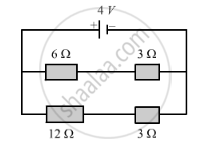
What is the value of:
(i) current through 6 Ω resistor?
(ii) potential difference across 12 Ω resistor?
How does the resistance of a metallic wire depend on its temperature? Explain with reason.
The figure shows a circuit. When the circuit is switched on, the ammeter reads 0.5 A.
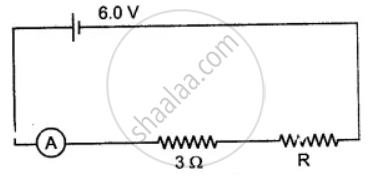
(i) Calculate the value of the unknown resistor R.
(ii) Calculate the charge passing through the 3 Ω resistor in 120 s.
(iii) Calculate the power dissipated in the 3 Ω resistor.
Find the potential difference required to flow a current of 300 mA in a wire of resistance 20 Ω.
