Advertisements
Advertisements
Question
Explain the statement ‘the potential difference between two points is 1 volt’.
Advertisements
Solution
One volt is the potential difference between two points in an electric circuit when 1 joule of work is done to move a charge of 1 coulomb from one point to another.
1 volt = `(1 "Joule")/(1 "Coloumb")`
APPEARS IN
RELATED QUESTIONS
State whether the resistivity of a wire changes with the change in the thickness of the wire.
Which of the following statements correctly defines a volt?
(a) a volt is a joule per ampere.
(b) a volt is a joule per coulomb.
Define one coulomb charge.
A current of 1.6 mA flows through a conductor. If charge on an electron is –1.6 × 10⁻¹⁹ coulomb, find the number of electrons that will pass each second through the cross section of that conductor.
Define the term ‘volt’.
Electric cells having 2V potential difference each have been connected in the form of a battery. What will be the total potential difference of the battery in both cases?


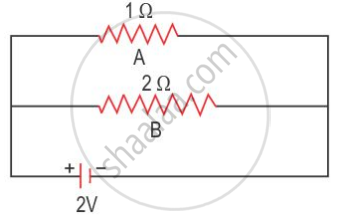
Calculate the current flowing through each of the resistors A and B in the circuit shown in the following figure.
A battery of 10 volt carries 20,000 C of charge through a resistance of 20 Ω. The work done in 10 seconds is:
A cylindrical conductor of length l and uniform area of cross section A has resistance R. Another conductor of length 2l and resistance R of the same material has area of cross section.
