Advertisements
Advertisements
Question
Draw a graph of Potential difference (V) versus Current (I) for an ohmic resistor. How can you find the resistance of the resistor from this graph?
Advertisements
Solution
We can find resistance by finding the slope of the graph.

Graph of V versus I for an Ohmic conductor
We can find resistance by finding the slope of the graph.
RELATED QUESTIONS
A battery of emf 12 V and internal resistance 2 Ω is connected with two resistors A and B of resistance 4 Ω and 6 Ω respectively joined in series.
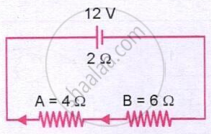
Find:
- Current in the circuit.
- The terminal voltage of the cell.
- The potential difference across 6Ω Resistor.
- Electrical energy spent per minute in the 4Ω resistor.
Calculate the work done in moving a charge of 4 coulombs from a point at 220 volts to another point at 230 volts.
The p.d. across a lamp is 12 V. How many joules of electrical energy are changed into heat and light when:
a charge of 5 C passes through it?
Keeping the resistance constant, the potential difference applied across the ends of a component is halved. By how much does the current change?
The device used for measuring potential difference is
From the following observations taken while determining the resistance of a conductor, draw the current-voltage graph and calculate the resistance of conductor. Is the conductor ohmic?
| Ammeter reading I (in ampere) | Voltmeter reading V (in volt) |
| 0.2 | 0.4 |
| 0.3 | 0.6 |
| 0.5 | 1.0 |
| 0.8 | 1.6 |
| 1.5 | 3.0 |
Five resistors of different resistances are connected together as shown in the figure. A 12 V battery is connected to the arrangement.
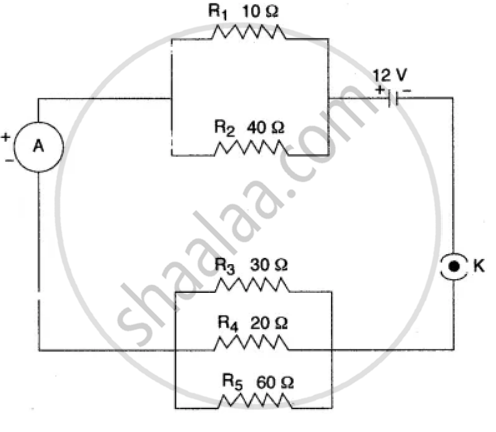
Calculate:
(i) the total resistance in the circuit
(ii) the total current flowing in the circuit.
A current of 100 mA. flows through a wire. The charge on an electron is 1.6 × 10⁻¹⁹ C. Find the number of electrons passing per second through the cross-section of the conductor.
How will you conclude that the same potential difference (voltage) exists across three resistors connected in a parallel arrangement to a battery?
Name a device that helps to maintain a potential difference across conductors.
