Advertisements
Advertisements
Questions
A battery of emf 12 V and internal resistance 2 Ω is connected with two resistors A and B of resistance 4 Ω and 6 Ω respectively joined in series.
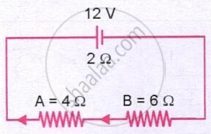
Find:
- Current in the circuit.
- The terminal voltage of the cell.
- The potential difference across 6Ω Resistor.
- Electrical energy spent per minute in the 4Ω resistor.
A battery of emf 12 V and internal resistance 2 Ω is connected with two resistors A and B of resistance 4 Ω and 6 Ω respectively joined in series.
Find:
- Current in the circuit.
- The terminal voltage of the cell.
- P.D across 6 Ω resistor.
- Electrical energy spent per minute in the 4Ω resistor.
Advertisements
Solution
The external resistors and internal resistance are all in series:
\[R_{\mathrm{total}}=4+6+2=12\ \Omega\]
= 12 Ω
(i) Current:
\[I=\frac{12}{12}\]
= 1 A
(ii) Terminal voltage is the voltage across the external circuit:
\[V_{\mathrm{terminal}}=I(4+6)\]
= 1 × 10
= 10 V
(iii) Potential difference across the \(6\ \Omega\) resistor:
\[V_6=IR\]
= 1 × 6
= 6 V
(iv) Energy spent in the \(4\ \Omega\) resistor in one minute:
\[E=I^2Rt\]
\[=1^2\times4\times60\]
= 240 J
RELATED QUESTIONS
By what other name is the unit joule/coulomb called?
Define one coulomb charge.
Name a device that help to measure the potential difference across a conductor.
Name a device which helps to maintain potential difference across a conductor (say, a bulb).
The p.d. across a lamp is 12 V. How many joules of electrical energy are changed into heat and light when:
a charge of 1 C passes through it?
Why do electricians wear rubber hand gloves while working with electricity?
The voltage across a 3Ω resistance is 6 V. How large is the current? What is
the resistance of a filament lamp when a voltage of 3 V across it causes a
current of 0.5 A?
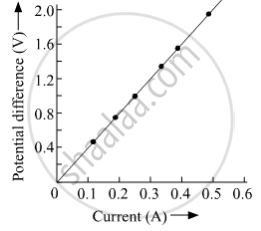
A V-I graph for a nichrome wire is given below. What do you infer from this graph? Draw a labelled circuit diagram to obtain such a graph.
Explain why potential difference is always less than the e.m.f. of a cell?
Potential near a charge is the measure of its ______ to bring a positive charge at that point.
