Advertisements
Advertisements
प्रश्न
A battery of emf 12 V and internal resistance 2 Ω is connected with two resistors A and B of resistance 4 Ω and 6 Ω respectively joined in series.
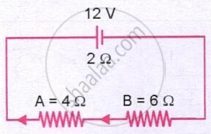
Find:
- Current in the circuit.
- The terminal voltage of the cell.
- The potential difference across 6Ω Resistor.
- Electrical energy spent per minute in the 4Ω resistor.
A battery of emf 12 V and internal resistance 2 Ω is connected with two resistors A and B of resistance 4 Ω and 6 Ω respectively joined in series.
Find:
- Current in the circuit.
- The terminal voltage of the cell.
- P.D across 6 Ω resistor.
- Electrical energy spent per minute in the 4Ω resistor.
Advertisements
उत्तर
The external resistors and internal resistance are all in series:
\[R_{\mathrm{total}}=4+6+2=12\ \Omega\]
= 12 Ω
(i) Current:
\[I=\frac{12}{12}\]
= 1 A
(ii) Terminal voltage is the voltage across the external circuit:
\[V_{\mathrm{terminal}}=I(4+6)\]
= 1 × 10
= 10 V
(iii) Potential difference across the \(6\ \Omega\) resistor:
\[V_6=IR\]
= 1 × 6
= 6 V
(iv) Energy spent in the \(4\ \Omega\) resistor in one minute:
\[E=I^2Rt\]
\[=1^2\times4\times60\]
= 240 J
संबंधित प्रश्न
What is a voltmeter?
A p.d. of 10 V is needed to make a current of 0.02 A flow through a wire. Wire p.d. is needed to make a current of 250 mA flow through the same wire?
In the circuit shown below:
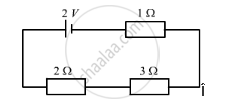
The potential difference across the 3 Ω resistor is:
If the potential difference between the ends of a fixed resistor is halved, the electric power will become:
The V-I graph for a series combination and for a parallel combination of two resistors is shown in Fig – 8.38. Which of the two, A or B, represents the parallel combination? Give a reason for your answer.
Define the following:
Potential difference
A battery of 10 volt carries 20,000 C of charge through a resistance of 20 Ω. The work done in 10 seconds is:
Electric potential is a ____________.
______ is work done per unit charge.
Inside a hollow charged spherical conductor, the potential ______
