Advertisements
Advertisements
Question
What do you understand by the resistance of a wire?
Advertisements
Solution
The obstruction offered in the flow of electrons (or current) by the material of the wire, is called its resistance.
RELATED QUESTIONS
What is the unit of electric charge?
Keeping the potential difference constant, the resistance of a circuit is doubled. By how much does the current change?
Keeping the potential difference constant, the resistance of a circuit is doubled. The current will become:
In the circuit shown below:
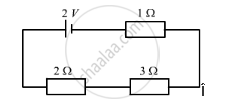
The potential difference across the 3 Ω resistor is:
How does the resistance of a metallic wire depend on its temperature? Explain with reason.
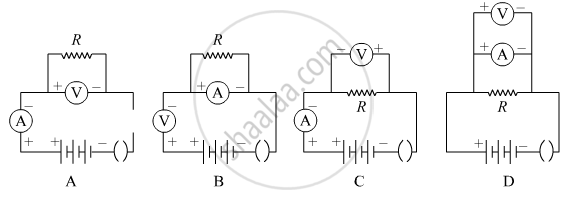
Which one of the following is the correct set-up for studying the dependence of the current on the potential difference across a resistor and why?
Suppose there are three resistors A, B, and C having resistances r1, r2, and r3 respectively. If R represents their equivalent resistance, establish the following relation `1/"R" = 1/"r"_1 + 1/"r"_2 + 1/"r"_3`, when joined in parallel.
The figure shows a circuit. When the circuit is switched on, the ammeter reads 0.5 A.
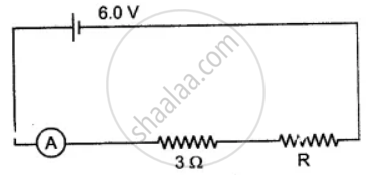
(i) Calculate the value of the unknown resistor R.
(ii) Calculate the charge passing through the 3 Ω resistor in 120 s.
(iii) Calculate the power dissipated in the 3 Ω resistor.
A cell of e.m.f 2.0 V and internal resistance 1Ω is connected to the resistors of 3Ω and 6Ω in series. Calculate:
(i) the current drawn from the cell,
(ii) the p.d. across each resistor,
(iii) the terminal voltage of the cell and
(iv) the voltage drop.
