Advertisements
Advertisements
प्रश्न
What do you understand by the resistance of a wire?
Advertisements
उत्तर
The obstruction offered in the flow of electrons (or current) by the material of the wire, is called its resistance.
संबंधित प्रश्न
You have three resistors of values 2Ω, 3Ω and 5Ω. How will you join them so that the total resistance is more than 7Ω?
1) Draw a diagram for the arrangement
2) Calculate the equivalent resistance.
If the potential difference between the end of a wire of fixed resistance is doubled, by how much does the electric power increase?
Calculate the power used in the 2 Ω resistor in each of the following circuits: a 6 V battery in series with 1 Ω and 2 Ω resistors.
A current of 0.2 A flows through a wire whose ends are at a potential difference of 15 V. Calculate:
(i) The resistance of the wire, and
(ii) The heat energy produced in 1 minute.
What would you suggest to a student if while performing an experiment he finds that the pointer/needle of the ammeter and voltmeter do not coincide with the zero marks on the scales when the circuit is open? No extra ammeter/voltmeter is available in the laboratory.
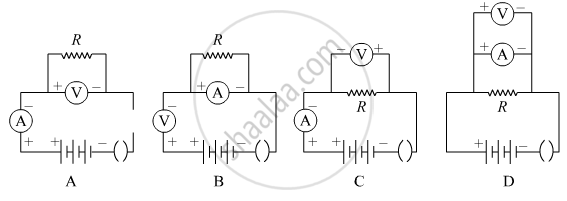
Which one of the following is the correct set-up for studying the dependence of the current on the potential difference across a resistor and why?
A 10 m long wire of a particular material is of resistance 5Ω What will be the resistance of 10m long wire of the same material but the double radius.
An electric charge always flows from a point at a ______ to a point at a ______.
Electric potential is a measure of the ______ on the unit positive charge to bring it to that point against all electrical forces.
