Advertisements
Advertisements
प्रश्न
A current of 0.2 A flows through a wire whose ends are at a potential difference of 15 V. Calculate:
(i) The resistance of the wire, and
(ii) The heat energy produced in 1 minute.
Advertisements
उत्तर
Given, current, I= 0.2 A; p.d. = 15 V
(i) A/C to Ohm's law
V=IR
R = `"v"/"I" = 15/0.2 = 75 Omega`
(ii) energy produced in one minutes is:
H=I2 Rt = (0.2)2 x 75 x 60 =180 J
APPEARS IN
संबंधित प्रश्न
Which device is used to measure p.d?
State whether a voltmeter has a high resistance of a low resistance. Give reason for your answer.
A current of 5 amperes flows through a wire whose ends are at a potential difference of 3 volts. Calculate the resistance of the wire.
Ohm's law state a relation between potential difference and ___________.
b. The values of potential difference V applied across a resistor and the correponding values of current I flowing in the resistor are given below:
| Potential difference, V (in volts) | : | 2.5 | 5.0 | 10.0 | 15.0 | 20.0 | 25.0 |
| Current, I (in amperes) | : | 0.1 | 0.2 | 0.4 | 0.6 | 0.8 | 1.0 |
Plot a graph between V and I, and calculate the resistance of the resistor.
c. Name the law which is illustrated by the above V-I graph.
Calculate the potential difference between the two terminals of a battery if 100 joules of work is required to transfer 20 coulombs of charge from one terminal of the battery to the other.
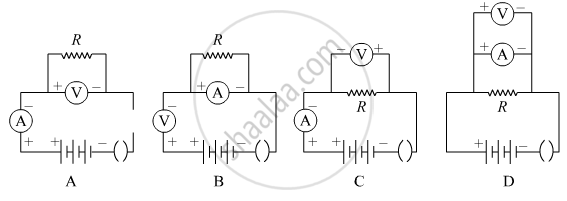
Which one of the following is the correct set-up for studying the dependence of the current on the potential difference across a resistor and why?
If P and V are the power and potential of device, the power consumed with a supply potential V1 is:
A current of 1 ampere flows in a series circuit containing an electric lamp and a conductor of 5 Ω when connected to a 10 V battery. Calculate the resistance of the electric lamp.
Now if a resistance of 10 Ω is connected in parallel with this series combination, what change (if any) in current flowing through 5 Ω conductor and potential difference across the lamp will take place? Give reason.
Inside a hollow charged spherical conductor, the potential ______
