Advertisements
Advertisements
प्रश्न
A 10 m long wire of a particular material is of resistance 5Ω What will be the resistance if the wire is doubled itself.
Advertisements
उत्तर
Given: The resistance of 10 m long wire = 5 Ω
On doubling the wire on itself the length is reduced to half and the area of cross-section is doubled so the resistance is reduced to one-fourth i.e. the resistance of the wire will become:
`1/4 xx 5 Omega = 1.25 Omega`
संबंधित प्रश्न
Which of the following statements correctly defines a volt?
(a) a volt is a joule per ampere.
(b) a volt is a joule per coulomb.
What is meant by saying that the electric potential at a point is 1 volt?
Define one coulomb charge.
What is the potential difference between the terminals of a battery if 250 joules of work is required to transfer 20 coulombs of charge from one terminal of battery to the other?
A V-I graph for a nichrome wire is given below. What do you infer from this graph? Draw a labelled circuit diagram to obtain such a graph.
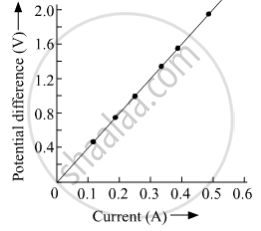
Find the resistance of a conductor if the electric current flowing through it is 0.35 A when the potential difference across it is 1.4 V.
Explain why potential difference is always less than the e.m.f. of a cell?
The figure shows a circuit. When the circuit is switched on, the ammeter reads 0.5 A.
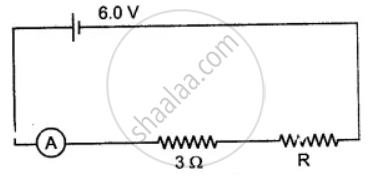
(i) Calculate the value of the unknown resistor R.
(ii) Calculate the charge passing through the 3 Ω resistor in 120 s.
(iii) Calculate the power dissipated in the 3 Ω resistor.
A current of 0.2 A flows through a conducting wire for 5 minutes. How much charge will flow?
A 10 m long wire of a particular material is of resistance 5Ω What will be the resistance of 10m long wire of the same material but the double radius.
