Advertisements
Advertisements
प्रश्न
A 10 m long wire of a particular material is of resistance 5Ω What will be the resistance if the wire is doubled itself.
Advertisements
उत्तर
Given: The resistance of 10 m long wire = 5 Ω
On doubling the wire on itself the length is reduced to half and the area of cross-section is doubled so the resistance is reduced to one-fourth i.e. the resistance of the wire will become:
`1/4 xx 5 Omega = 1.25 Omega`
संबंधित प्रश्न
What is the potential difference between the terminals of a battery if 250 joules of work is required to transfer 20 coulombs of charge from one terminal of battery to the other?
Why do electricians wear rubber hand gloves while working with electricity?
What current will be taken by a 920 W appliance if the supply voltage is 230 V?
State the S.I. unit of electric potential.
The differences between the electrostatic potential of the positive and the negative end of an electric cell is the ______ of the cell.
Three resistors are connected to a 12 V battery as shown in the figure given below:
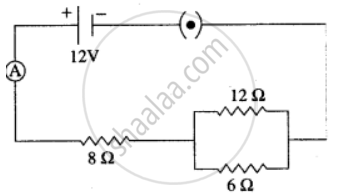
(i) What is the current through the 8 ohm resistor?
(ii) What is the potential difference across the parallel combination of 6 ohm and 12 ohm resistor?
(iii) What is the current through the 6 ohm resistor?
Three resistors are connected to a 6 V battery as shown in the figure given below:
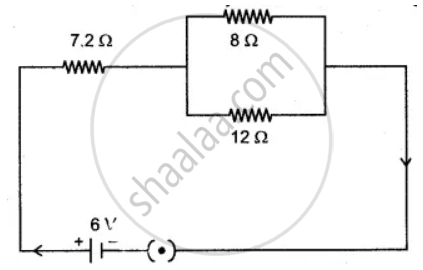
Calculate:
(i) the equivalent resistance of the circuit.
(ii) total current in the circuit.
(iii) potential difference across the 7.2 Ω resistor.
A current of 100 mA. flows through a wire. The charge on an electron is 1.6 × 10⁻¹⁹ C. Find the number of electrons passing per second through the cross-section of the conductor.
An electric bulb draws 0.5 A current at 3.0 V. Calculate the resistance of the filament of the bulb.
A cylindrical conductor of length l and uniform area of cross section A has resistance R. Another conductor of length 2l and resistance R of the same material has area of cross section.
