Advertisements
Advertisements
प्रश्न
Three resistors are connected to a 6 V battery as shown in the figure given below:
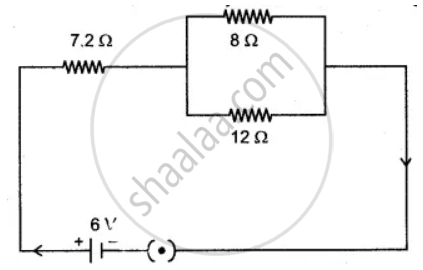
Calculate:
(i) the equivalent resistance of the circuit.
(ii) total current in the circuit.
(iii) potential difference across the 7.2 Ω resistor.
Advertisements
उत्तर
(i) `1/"R"_1 = 1/8 + 1/12`
`= (3 + 2)/24 = 5/24`
R1 = 4.8 ohm.
Total Resistance = 4.8 + 7.2 = 12 ohm
(ii) V = IR
6 = I × 12
I = 0.5 Amp.
(iii) V = IR
= 0.5 × 7.2
= 3.6 Volt.
APPEARS IN
संबंधित प्रश्न
Calculate the quantity of heat produced in a 20 Ω resistor carrying 2.5 A current in 5 minutes.
You have three resistors of values 2Ω, 3Ω and 5Ω. How will you join them so that the total resistance is more than 7Ω?
1) Draw a diagram for the arrangement
2) Calculate the equivalent resistance.
Define one coulomb charge.
State whether a voltmeter has a high resistance of a low resistance. Give reason for your answer.
If a potential difference of 10 V causes a current of 2 A to flow for 1 minute, how much energy is transferred?
Why do electricians wear rubber hand gloves while working with electricity?
Write down the formula which states the relation between potential difference, current, and resistance.
A current of 100 mA. flows through a wire. The charge on an electron is 1.6 × 10⁻¹⁹ C. Find the number of electrons passing per second through the cross-section of the conductor.
Conceptual question.
Does a solar cell always maintain the potential across its terminals constant? Discuss
Study the following circuit and find:

- Effective resistance of the circuit
- Current drawn from the battery
- Potential difference across the 5 omega resistor
