Advertisements
Advertisements
प्रश्न
Three resistors are connected to a 6 V battery as shown in the figure given below:
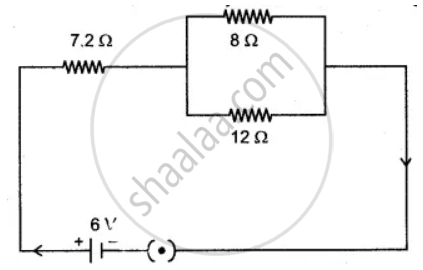
Calculate:
(i) the equivalent resistance of the circuit.
(ii) total current in the circuit.
(iii) potential difference across the 7.2 Ω resistor.
Advertisements
उत्तर
(i) `1/"R"_1 = 1/8 + 1/12`
`= (3 + 2)/24 = 5/24`
R1 = 4.8 ohm.
Total Resistance = 4.8 + 7.2 = 12 ohm
(ii) V = IR
6 = I × 12
I = 0.5 Amp.
(iii) V = IR
= 0.5 × 7.2
= 3.6 Volt.
APPEARS IN
संबंधित प्रश्न
The values of current I flowing in a given resistor for the corresponding values of potential difference V across the resistor are given below:
| I (amperes) | 0.5 | 1.0 | 2.0 | 3.0 | 4.0 |
| V (volts) | 1.6 | 3.4 | 6.7 | 10.2 | 13.2 |
Plot a graph between V and I and calculate the resistance of that resistor.
What is a voltmeter?
A potential difference of 20 volts is applied across the ends of a resistance of 5 ohms. What current will flow in the resistance?
A current of 200 mA flows through a 4 kΩ resistor. What is the p.d. across the resistor?
Three electric cells of potential difference 1.5 V each have been connected as a battery. The potential differences of the battery will be ____________ V.
Find the resistance of a conductor if the electric current flowing through it is 0.35 A when the potential difference across it is 1.4 V.
A boy records that 4000 joules of work are required to transfer 10 coulombs of charge between two points of a resistor of 50 Ω. The current passing through it is:
A current of 1 ampere flows in a series circuit containing an electric lamp and a conductor of 5 Ω when connected to a 10 V battery. Calculate the resistance of the electric lamp.
Now if a resistance of 10 Ω is connected in parallel with this series combination, what change (if any) in current flowing through 5 Ω conductor and potential difference across the lamp will take place? Give reason.
A negative charge will move from ______ to ______ potential.
What is the measure of the work done on the unit positive charge to bring it to that point against all electrical forces?
