Advertisements
Advertisements
Question
Three resistors are connected to a 6 V battery as shown in the figure given below:
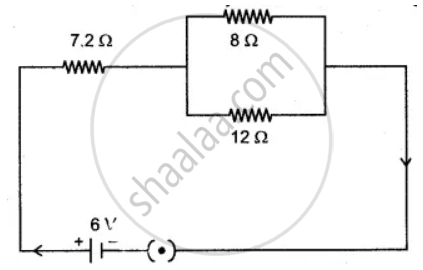
Calculate:
(i) the equivalent resistance of the circuit.
(ii) total current in the circuit.
(iii) potential difference across the 7.2 Ω resistor.
Advertisements
Solution
(i) `1/"R"_1 = 1/8 + 1/12`
`= (3 + 2)/24 = 5/24`
R1 = 4.8 ohm.
Total Resistance = 4.8 + 7.2 = 12 ohm
(ii) V = IR
6 = I × 12
I = 0.5 Amp.
(iii) V = IR
= 0.5 × 7.2
= 3.6 Volt.
APPEARS IN
RELATED QUESTIONS
You have three resistors of values 2Ω, 3Ω and 5Ω. How will you join them so that the total resistance is more than 7Ω?
1) Draw a diagram for the arrangement
2) Calculate the equivalent resistance.
Name a device which helps to maintain potential difference across a conductor (say, a bulb).
If a potential difference of 10 V causes a current of 2 A to flow for 1 minute, how much energy is transferred?
Keeping the potential difference constant, the resistance of a circuit is halved. By how much does the current change?
A current of 200 mA flows through a 4 kΩ resistor. What is the p.d. across the resistor?
Write an expression for the electrical power spent in flow of current through a conductor in terms of current and resistance.
Find the resistance of a conductor if the electric current flowing through it is 0.35 A when the potential difference across it is 1.4 V.
Potential near a charge is the measure of its ______ to bring a positive charge at that point.
The SI unit of potential difference is ______.
Study the following circuit and find:

- Effective resistance of the circuit
- Current drawn from the battery
- Potential difference across the 5 omega resistor
