Advertisements
Advertisements
Question
Define electric potential and potential difference.
Advertisements
Solution
- Electric Potential: The electric potential at a point is defined as the amount of work done in moving a unit positive charge from infinity to that point against the electric force.
- Electric Potential Difference: The electric potential difference between two points is defined as the amount of work done in moving a unit positive charge from one point to another point against the electric force.
APPEARS IN
RELATED QUESTIONS
The values of current I flowing in a given resistor for the corresponding values of potential difference V across the resistor are given below:
| I (amperes) | 0.5 | 1.0 | 2.0 | 3.0 | 4.0 |
| V (volts) | 1.6 | 3.4 | 6.7 | 10.2 | 13.2 |
Plot a graph between V and I and calculate the resistance of that resistor.
By what other name is the unit joule/coulomb called?
The p.d. across a lamp is 12 V. How many joules of electrical energy are changed into heat and light when: a current of 2 A flows through it for 10 s?
A current of 200 mA flows through a 4 kΩ resistor. What is the p.d. across the resistor?
Calculate the power used in the 2 Ω resistor in each of the following circuits: a 6 V battery in series with 1 Ω and 2 Ω resistors.
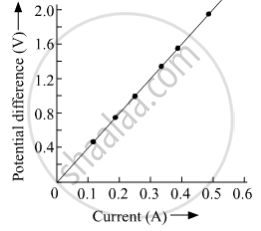
A V-I graph for a nichrome wire is given below. What do you infer from this graph? Draw a labelled circuit diagram to obtain such a graph.
A cylindrical conductor of length l and uniform area of cross section A has resistance R. Another conductor of length 2l and resistance R of the same material has area of cross section.
Assertion (A): Charges flow from higher potential to lower potential.
Reason (R): Current flows mainly due to the flow of electrons.
