Advertisements
Advertisements
प्रश्न
Define electric potential and potential difference.
Advertisements
उत्तर
- Electric Potential: The electric potential at a point is defined as the amount of work done in moving a unit positive charge from infinity to that point against the electric force.
- Electric Potential Difference: The electric potential difference between two points is defined as the amount of work done in moving a unit positive charge from one point to another point against the electric force.
APPEARS IN
संबंधित प्रश्न
What do you understand by the term "potential difference"?
The p.d. across a lamp is 12 V. How many joules of electrical energy are changed into heat and light when: a current of 2 A flows through it for 10 s?
Name the law which relates the current in a conductor to the potential difference across its ends.
Keeping the potential difference constant, the resistance of a circuit is halved. By how much does the current change?
A resistance of 20 ohms has a current of 2 amperes flowing in it. What potential difference is there between its ends?
Define the following:
Potential difference
Explain why potential difference is always less than the e.m.f. of a cell?
Five resistors of different resistances are connected together as shown in the figure. A 12 V battery is connected to the arrangement.
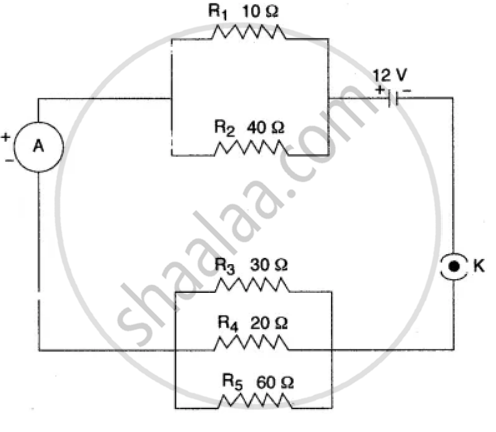
Calculate:
(i) the total resistance in the circuit
(ii) the total current flowing in the circuit.
A 10 m long wire of a particular material is of reistance 5Ω What will be the resistance of 5m long wire of same material and the same thickness.
Find the potential difference required to flow a current of 300 mA in a wire of resistance 20 Ω.
