Advertisements
Advertisements
प्रश्न
A battery of emf 12 V and internal resistance 2 Ω is connected with two resistors A and B of resistance 4 Ω and 6 Ω respectively joined in series.
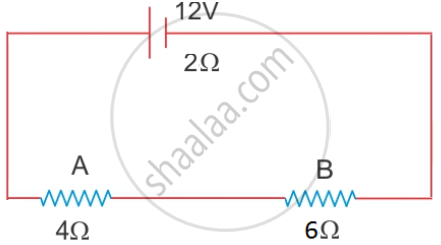
Find:
1) Current in the circuit
2) The terminal voltage of the cell
3) The potential difference across 6Ω Resistor
4) Electrical energy spent per minute in the 4Ω resistor.
Advertisements
उत्तर
E = 12 V; ri = 2 Ω; RA = 4 Ω; RB = 6 Ω
1) The current in the circuit is
`I = E/R_"total" = E/(r_i + r_A + r_B)`
`:. I = 12/(2+4+6) = 1 A`
2) The terminal voltage of the cell is
V = E - Iri
∴ V = 12 - (1 x 2) = 12 - 2 = 10 V
3) The potential difference across the 6 Ω is
VB = IRB
∴ VB = 1 x 6 = 6V
4) The electrical energy spent per minute (=60 s) is
E = I2Rt
E = 12 X 4 X 60 = 240J
APPEARS IN
संबंधित प्रश्न
Which of the following statements correctly defines a volt?
(a) a volt is a joule per ampere.
(b) a volt is a joule per coulomb.
What is the unit of electric charge?
Define one coulomb charge.
State the relation between potential difference, work done and charge moved.
What do you understand by the term "potential difference"?
Keeping the potential difference constant, the resistance of a circuit is doubled. The current will become:
Calculate the power used in the 2 Ω resistor in each of the following circuits: a 6 V battery in series with 1 Ω and 2 Ω resistors.
The figure shows a circuit. When the circuit is switched on, the ammeter reads 0.5 A.
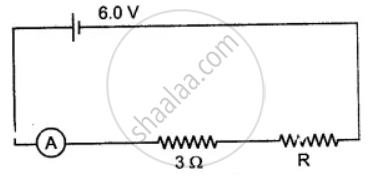
(i) Calculate the value of the unknown resistor R.
(ii) Calculate the charge passing through the 3 Ω resistor in 120 s.
(iii) Calculate the power dissipated in the 3 Ω resistor.
A battery of 10 volt carries 20,000 C of charge through a resistance of 20 Ω. The work done in 10 seconds is:
Two charged spherical conductors of radius R1 and R2 are connected by a wire. Then the ratio of surface charge densities of the spheres (σ1/σ2 ) is ______
