Advertisements
Advertisements
प्रश्न
A battery of emf 12 V and internal resistance 2 Ω is connected with two resistors A and B of resistance 4 Ω and 6 Ω respectively joined in series.
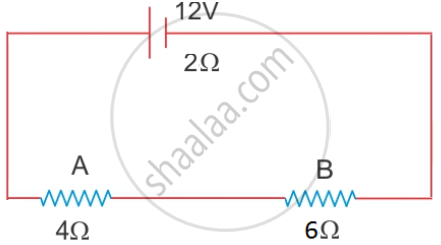
Find:
1) Current in the circuit
2) The terminal voltage of the cell
3) The potential difference across 6Ω Resistor
4) Electrical energy spent per minute in the 4Ω resistor.
Advertisements
उत्तर
E = 12 V; ri = 2 Ω; RA = 4 Ω; RB = 6 Ω
1) The current in the circuit is
`I = E/R_"total" = E/(r_i + r_A + r_B)`
`:. I = 12/(2+4+6) = 1 A`
2) The terminal voltage of the cell is
V = E - Iri
∴ V = 12 - (1 x 2) = 12 - 2 = 10 V
3) The potential difference across the 6 Ω is
VB = IRB
∴ VB = 1 x 6 = 6V
4) The electrical energy spent per minute (=60 s) is
E = I2Rt
E = 12 X 4 X 60 = 240J
APPEARS IN
संबंधित प्रश्न
By what other name is the unit joule/coulomb called?
What do the letters p.d. stand for?
Define one coulomb charge.
What is Ohm's law? Explain how it is used to define the unit of resistance.
What p.d. is needed to send a current of 6 A through an electrical appliance having a resistance of 40 Ω?
Explain the statement ‘the potential difference between two points is 1 volt’.
A battery of 10 volt carries 20,000 C of charge through a resistance of 20 Ω. The work done in 10 seconds is:
A cylindrical conductor of length l and uniform area of cross section A has resistance R. Another conductor of length 2l and resistance R of the same material has area of cross section.
Electric potential is a measure of the ______ on the unit positive charge to bring it to that point against all electrical forces.
