Advertisements
Advertisements
प्रश्न
A current of 0.2 A flows through a conducting wire for 5 minutes. How much charge will flow?
Advertisements
उत्तर
Given: I = 0.2A, t = 5 minute = 5 × 60s = 300s.
Charge Q = I × t = 0.2 × 300 = 60 C.
संबंधित प्रश्न
Calculate the quantity of heat produced in a 20 Ω resistor carrying 2.5 A current in 5 minutes.
You have three resistors of values 2Ω, 3Ω and 5Ω. How will you join them so that the total resistance is more than 7Ω?
1) Draw a diagram for the arrangement
2) Calculate the equivalent resistance.
What is meant by saying that the electric potential at a point is 1 volt?
Name a device which helps to maintain potential difference across a conductor (say, a bulb).
Keeping the resistance constant, the potential difference applied across the ends of a component is halved. By how much does the current change?
Keeping the potential difference constant, the resistance of a circuit is halved. By how much does the current change?
A potential difference of 20 volts is applied across the ends of a resistance of 5 ohms. What current will flow in the resistance?
A current of 200 mA flows through a 4 kΩ resistor. What is the p.d. across the resistor?
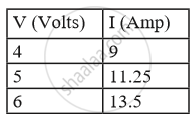
The following table shows current in Amperes and potential difference in Volts.
What will be the nature of the graph between the current and potential difference? (Do not draw a graph.)
Point out two differences between e.m.f. and potential difference as applied to electric circuits.
