Advertisements
Advertisements
प्रश्न
A current of 1.6 mA flows through a conductor. If charge on an electron is –1.6 × 10⁻¹⁹ coulomb, find the number of electrons that will pass each second through the cross section of that conductor.
Advertisements
उत्तर
Current, I = 1.6 mA = 1.6 × 10⁻³ A
Charge, Q = -1.6 × 10⁻¹⁹ coulomb
t = 1 sec
Charge flowing through the conductor in one second
I = `"Q"/"t"`
Q = I × t
Substituting the values in the formula above we get,
Q = 1.6 × 10-3 × 1
= 1.6 × 10⁻³
No. of electrons = `(1.6 xx10^-3)/(1.6xx10^-19)`
= `10^16`
Therefore, the number of electrons that will pass each second through the cross section of that conductor = 1016
संबंधित प्रश्न
The device used for measuring potential difference is known as:
For the circuit shown in the diagram below:
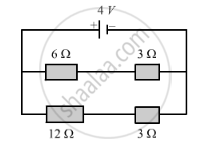
What is the value of:
(i) current through 6 Ω resistor?
(ii) potential difference across 12 Ω resistor?
What do you understand by the resistance of a wire?
Suppose there are three resistors A, B, and C having resistances r1, r2, and r3 respectively. If R represents their equivalent resistance, establish the following relation R = r1 + r2 + r3 when joined in series.
A cell of e.m.f 2.0 V and internal resistance 1Ω is connected to the resistors of 3Ω and 6Ω in series. Calculate:
(i) the current drawn from the cell,
(ii) the p.d. across each resistor,
(iii) the terminal voltage of the cell and
(iv) the voltage drop.
An electric bulb draws 0.5 A current at 3.0 V. Calculate the resistance of the filament of the bulb.
State Ohm’s law.
Assertion (A): Charges flow from higher potential to lower potential.
Reason (R): Current flows mainly due to the flow of electrons.
Two charged spherical conductors of radius R1 and R2 are connected by a wire. Then the ratio of surface charge densities of the spheres `(σ_1//σ_2 )` is ______.
