Advertisements
Advertisements
Question
A current of 1.6 mA flows through a conductor. If charge on an electron is –1.6 × 10⁻¹⁹ coulomb, find the number of electrons that will pass each second through the cross section of that conductor.
Advertisements
Solution
Current, I = 1.6 mA = 1.6 × 10⁻³ A
Charge, Q = -1.6 × 10⁻¹⁹ coulomb
t = 1 sec
Charge flowing through the conductor in one second
I = `"Q"/"t"`
Q = I × t
Substituting the values in the formula above we get,
Q = 1.6 × 10-3 × 1
= 1.6 × 10⁻³
No. of electrons = `(1.6 xx10^-3)/(1.6xx10^-19)`
= `10^16`
Therefore, the number of electrons that will pass each second through the cross section of that conductor = 1016
RELATED QUESTIONS
State whether the resistivity of a wire changes with the change in the thickness of the wire.
Define the unit of resistance (or Define the unit "ohm").
How is the electric potential difference between the two points defined? State its S.I. unit.
The V-I graph for a series combination and for a parallel combination of two resistors is shown in Fig – 8.38. Which of the two, A or B, represents the parallel combination? Give a reason for your answer.
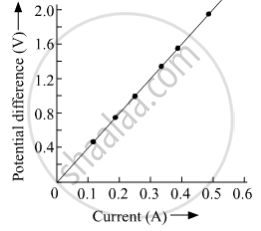
A V-I graph for a nichrome wire is given below. What do you infer from this graph? Draw a labelled circuit diagram to obtain such a graph.
A current of 0.2 A flows through a conducting wire for 5 minutes. How much charge will flow?
Exercise.
Calculate the amount of charge that would flow in 2 hours through an element of an electric bulb drawing a current of 2.5 A.
A boy records that 4000 joules of work are required to transfer 10 coulombs of charge between two points of a resistor of 50 Ω. The current passing through it is:
What does the positive and negative sign of potential convey?
