Advertisements
Advertisements
प्रश्न
A current of 1.6 mA flows through a conductor. If charge on an electron is –1.6 × 10⁻¹⁹ coulomb, find the number of electrons that will pass each second through the cross section of that conductor.
Advertisements
उत्तर
Current, I = 1.6 mA = 1.6 × 10⁻³ A
Charge, Q = -1.6 × 10⁻¹⁹ coulomb
t = 1 sec
Charge flowing through the conductor in one second
I = `"Q"/"t"`
Q = I × t
Substituting the values in the formula above we get,
Q = 1.6 × 10-3 × 1
= 1.6 × 10⁻³
No. of electrons = `(1.6 xx10^-3)/(1.6xx10^-19)`
= `10^16`
Therefore, the number of electrons that will pass each second through the cross section of that conductor = 1016
संबंधित प्रश्न
State whether a voltmeter has a high resistance of a low resistance. Give reason for your answer.
100 joules of heat is produced per second in a 4 ohm resistor. What is the potential difference across the resistor?
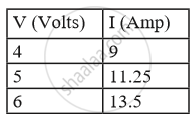
The following table shows current in Amperes and potential difference in Volts.
What will be the nature of the graph between the current and potential difference? (Do not draw a graph.)
Three electric cells of potential difference 1.5 V each have been connected as a battery. The potential differences of the battery will be ____________ V.
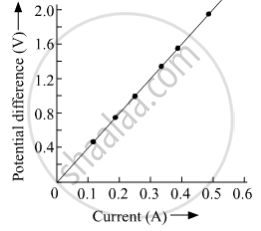
A V-I graph for a nichrome wire is given below. What do you infer from this graph? Draw a labelled circuit diagram to obtain such a graph.
Five resistors of different resistances are connected together as shown in the figure. A 12 V battery is connected to the arrangement.
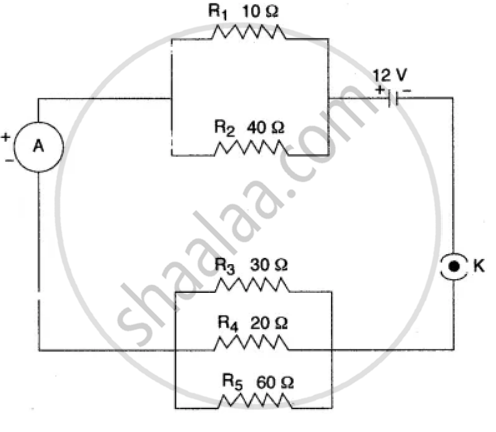
Calculate:
(i) the total resistance in the circuit
(ii) the total current flowing in the circuit.
Suppose there are three resistors A, B, and C having resistances r1, r2, and r3 respectively. If R represents their equivalent resistance, establish the following relation `1/"R" = 1/"r"_1 + 1/"r"_2 + 1/"r"_3`, when joined in parallel.
In the figure given below, A, B and C are three ammeters. The ammeter B reads 0.5A. (All the ammeters have negligible resistance.)
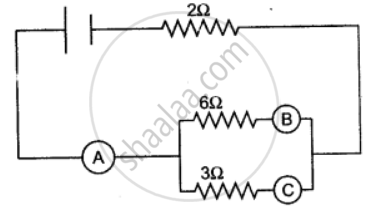
Calculate:
(i) the readings in the ammeters A and C.
(ii) the total resistance of the circuit.
Electric potential is a ____________.
Inside a hollow charged spherical conductor, the potential ______
