Advertisements
Advertisements
Question
Two bulbs are marked 100 W, 220 V and 60 W, 110 V. Calculate the ratio of their resistances.
Advertisements
Solution
Given Ist Bulb
P1 = 100 W
V1 = 220 V
IInd Bulb
P2 = 60 W
V2 = 110V
We know P = `"V"^2/"R"`
So R = `"V"^2/"P"`
So `"R"_1/"R"_2 = ("V"_1^2/"P"_1)/("V"_2^2/"P"_2)`
`= ("V"_1^2 xx "P"_2)/("P"_1 xx "V"_2^2)`
`= (220^2 xx 60)/(100 xx 110 xx 110) = 2.4`
RELATED QUESTIONS
You have three resistors of values 2Ω, 3Ω and 5Ω. How will you join them so that the total resistance is more than 7Ω?
1) Draw a diagram for the arrangement
2) Calculate the equivalent resistance.
How much work is done in moving a charge of 2 C across two points having a potential difference of 12 V?
The p.d. across a lamp is 12 V. How many joules of electrical energy are changed into heat and light when:
a charge of 1 C passes through it?
Define the term ‘volt’.
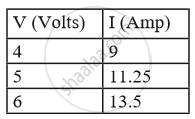
The following table shows current in Amperes and potential difference in Volts.
Which law will the graph prove? Explain the law.
The voltage across a 3Ω resistance is 6 V. How large is the current? What is
the resistance of a filament lamp when a voltage of 3 V across it causes a
current of 0.5 A?
A current of 0.2 A flows through a conducting wire for 5 minutes. How much charge will flow?
An electric bulb draws 0.5 A current at 3.0 V. Calculate the resistance of the filament of the bulb.
Inside a hollow charged spherical conductor, the potential ______
Find the potential difference required to flow a current of 300 mA in a wire of resistance 20 Ω.
