Advertisements
Advertisements
प्रश्न
Two bulbs are marked 100 W, 220 V and 60 W, 110 V. Calculate the ratio of their resistances.
Advertisements
उत्तर
Given Ist Bulb
P1 = 100 W
V1 = 220 V
IInd Bulb
P2 = 60 W
V2 = 110V
We know P = `"V"^2/"R"`
So R = `"V"^2/"P"`
So `"R"_1/"R"_2 = ("V"_1^2/"P"_1)/("V"_2^2/"P"_2)`
`= ("V"_1^2 xx "P"_2)/("P"_1 xx "V"_2^2)`
`= (220^2 xx 60)/(100 xx 110 xx 110) = 2.4`
संबंधित प्रश्न
Calculate the quantity of heat produced in a 20 Ω resistor carrying 2.5 A current in 5 minutes.
How much work is done in moving a charge of 2 C across two points having a potential difference of 12 V?
What is the potential difference between the terminals of a battery if 250 joules of work is required to transfer 20 coulombs of charge from one terminal of battery to the other?
A potential difference of 20 volts is applied across the ends of a resistance of 5 ohms. What current will flow in the resistance?
What is the ratio of potential difference and current known as?
How does the resistance of a metallic wire depend on its temperature? Explain with reason.
Define the following:
Potential difference
Write an expression for the electrical power spent in flow of current through a conductor in terms of current and resistance.
Five resistors of different resistances are connected together as shown in the figure. A 12 V battery is connected to the arrangement.
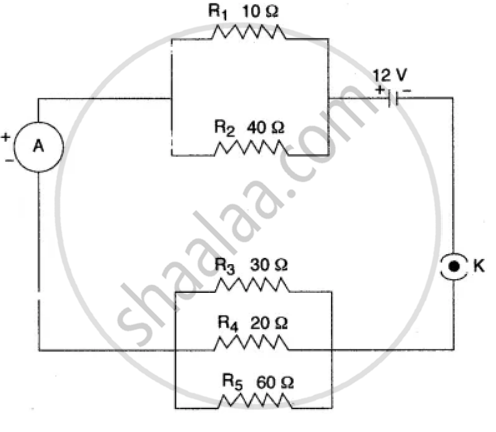
Calculate:
(i) the total resistance in the circuit
(ii) the total current flowing in the circuit.
Exercise.
Calculate the amount of charge that would flow in 2 hours through an element of an electric bulb drawing a current of 2.5 A.
