Advertisements
Advertisements
Question
A battery of emf 12 V and internal resistance 2 Ω is connected with two resistors A and B of resistance 4 Ω and 6 Ω respectively joined in series.
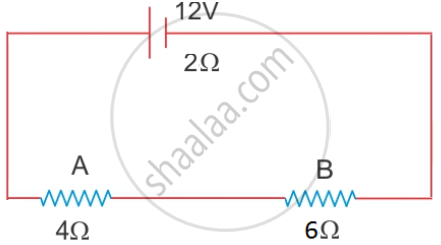
Find:
1) Current in the circuit
2) The terminal voltage of the cell
3) The potential difference across 6Ω Resistor
4) Electrical energy spent per minute in the 4Ω resistor.
Advertisements
Solution
E = 12 V; ri = 2 Ω; RA = 4 Ω; RB = 6 Ω
1) The current in the circuit is
`I = E/R_"total" = E/(r_i + r_A + r_B)`
`:. I = 12/(2+4+6) = 1 A`
2) The terminal voltage of the cell is
V = E - Iri
∴ V = 12 - (1 x 2) = 12 - 2 = 10 V
3) The potential difference across the 6 Ω is
VB = IRB
∴ VB = 1 x 6 = 6V
4) The electrical energy spent per minute (=60 s) is
E = I2Rt
E = 12 X 4 X 60 = 240J
APPEARS IN
RELATED QUESTIONS
State two causes of energy loss in a transformer.
Which device is used to measure p.d?
The p.d. across a lamp is 12 V. How many joules of electrical energy are changed into heat and light when:
a charge of 5 C passes through it?
A p.d. of 10 V is needed to make a current of 0.02 A flow through a wire. Wire p.d. is needed to make a current of 250 mA flow through the same wire?
What would you suggest to a student if while performing an experiment he finds that the pointer/needle of the ammeter and voltmeter do not coincide with the zero marks on the scales when the circuit is open? No extra ammeter/voltmeter is available in the laboratory.
A current of 0.2 A flows through a conducting wire for 5 minutes. How much charge will flow?
Define electric potential and potential difference.
If P and V are the power and potential of device, the power consumed with a supply potential V1 is:
Assertion (A): Charges flow from higher potential to lower potential.
Reason (R): Current flows mainly due to the flow of electrons.
Study the following circuit and find:

- Effective resistance of the circuit
- Current drawn from the battery
- Potential difference across the 5 omega resistor
