Advertisements
Advertisements
Question
A current of 0.2 A flows through a conducting wire for 5 minutes. How much charge will flow?
Advertisements
Solution
Given: I = 0.2A, t = 5 minute = 5 × 60s = 300s.
Charge Q = I × t = 0.2 × 300 = 60 C.
RELATED QUESTIONS
State two causes of energy loss in a transformer.
What do you understand by the term "potential difference"?
What is the potential difference between the terminals of a battery if 250 joules of work is required to transfer 20 coulombs of charge from one terminal of battery to the other?
Name a device which helps to maintain potential difference across a conductor (say, a bulb).
Name the law which relates the current in a conductor to the potential difference across its ends.
In the circuit shown below:
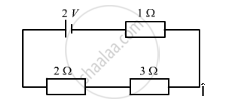
The potential difference across the 3 Ω resistor is:
Explain why potential difference is always less than the e.m.f. of a cell?
Two bulbs are marked 100 W, 220 V and 60 W, 110 V. Calculate the ratio of their resistances.
A 10 m long wire of a particular material is of resistance 5Ω What will be the resistance if the wire is stretched to double its length?
Conceptual question.
A bird sitting on a high power electric line is still safe. How?
