Advertisements
Advertisements
Question
Point out two differences between e.m.f. and potential difference as applied to electric circuits.
Advertisements
Solution
Electromotive force or e.m.f. of a cell is potential difference between its two electrodes when it is in open circuit, i.e., not sending current in the external circuit; while potential difference is the difference in potential between the terminals when the cell is in closed circuit or it is sending current in the given circuits, e.m.f. is always greater than potential difference or terminal voltage of a cell on account of energy being spent in driving charge through the circuit.
RELATED QUESTIONS
How much energy is given to each coulomb of charge passing through a 6 V battery?
How much work is done in moving a charge of 2 C across two points having a potential difference of 12 V?
Electric cells having 2V potential difference each have been connected in the form of a battery. What will be the total potential difference of the battery in both cases?


The voltage across a 3Ω resistance is 6 V. How large is the current? What is
the resistance of a filament lamp when a voltage of 3 V across it causes a
current of 0.5 A?
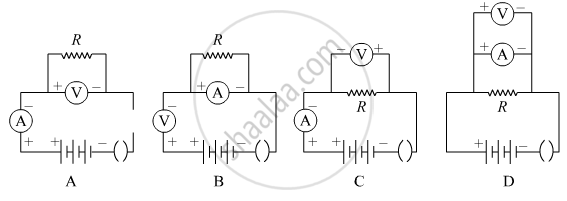
Which one of the following is the correct set-up for studying the dependence of the current on the potential difference across a resistor and why?
A cell of e.m.f 2.0 V and internal resistance 1Ω is connected to the resistors of 3Ω and 6Ω in series. Calculate:
(i) the current drawn from the cell,
(ii) the p.d. across each resistor,
(iii) the terminal voltage of the cell and
(iv) the voltage drop.
An electric bulb draws 0.5 A current at 3.0 V. Calculate the resistance of the filament of the bulb.
A 10 m long wire of a particular material is of resistance 5Ω What will be the resistance if the wire is doubled itself.
Name a device that helps to maintain a potential difference across conductors.
Inside a hollow charged spherical conductor, the potential ______
