Advertisements
Advertisements
Question
In the figure given below, A, B and C are three ammeters. The ammeter B reads 0.5A. (All the ammeters have negligible resistance.)
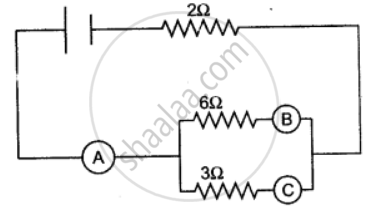
Calculate:
(i) the readings in the ammeters A and C.
(ii) the total resistance of the circuit.
Advertisements
Solution
(i) P.d. across 6 Ω = P. d. across 3 Ω
Or 6 × 0.5 = 3 × ic
Or ic i.e., current passing through the ammeter C is:
`(6 xx 0.5)/3 = 1.0`ampere
(ii) Here, `1/"R" = 1/6 + 1/3 = 3/6 = 1/2`
or R = 2 Ω
∴ Total ressistance of the circuit = 2Ω + R = 2Ω + 2Ω = 4Ω
∴ Current through A = Current passing through B + current passing through C
= 0.5 + 1.0 = 1.5 ampere
RELATED QUESTIONS
State the relation between potential difference, work done and charge moved.
What do you understand by the term "potential difference"?
How is a voltmeter connected in the circuit to measure the potential difference between two points? Explain with the help of a diagram.
Why do electricians wear rubber hand gloves while working with electricity?
b. The values of potential difference V applied across a resistor and the correponding values of current I flowing in the resistor are given below:
| Potential difference, V (in volts) | : | 2.5 | 5.0 | 10.0 | 15.0 | 20.0 | 25.0 |
| Current, I (in amperes) | : | 0.1 | 0.2 | 0.4 | 0.6 | 0.8 | 1.0 |
Plot a graph between V and I, and calculate the resistance of the resistor.
c. Name the law which is illustrated by the above V-I graph.
100 joules of heat is produced per second in a 4 ohm resistor. What is the potential difference across the resistor?
A current of 0.2 A flows through a conducting wire for 5 minutes. How much charge will flow?
Define electric potential and potential difference.
Name a device that helps to maintain a potential difference across conductors.
Two charged spherical conductors of radius R1 and R2 are connected by a wire. Then the ratio of surface charge densities of the spheres `(σ_1//σ_2 )` is ______.
