Advertisements
Advertisements
Question
How does the resistance of a metallic wire depend on its temperature? Explain with reason.
Advertisements
Solution 1
With the increase in temperature of conductor, both the random motion of electrons and the amplitude of vibration of fixed positive ions increase. As a result, the number of collisions increases. Hence, the resistance of a conductor increases with the increase in its temperature. The resistance of filament of a bulb is more when it is glowing (i.e., when it is at a high temperature) as compared to when it is not glowing (i.e., when it is cold).
Solution 2
The resistance of a metallic wire increases with increase in its temperature.
APPEARS IN
RELATED QUESTIONS
A battery of emf 12 V and internal resistance 2 Ω is connected with two resistors A and B of resistance 4 Ω and 6 Ω respectively joined in series.
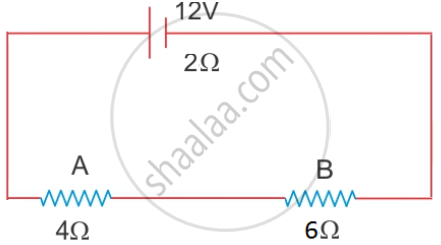
Find:
1) Current in the circuit
2) The terminal voltage of the cell
3) The potential difference across 6Ω Resistor
4) Electrical energy spent per minute in the 4Ω resistor.
State whether the resistivity of a wire changes with the change in the thickness of the wire.
What do the letters p.d. stand for?
Write down the formula which states the relation between potential difference, current, and resistance.
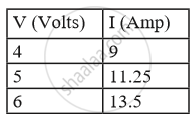
The following table shows current in Amperes and potential difference in Volts.
What will be the nature of the graph between the current and potential difference? (Do not draw a graph.)
State whether the potential is a scalar or vector?
Point out two differences between e.m.f. and potential difference as applied to electric circuits.
A cell of e.m.f 2.0 V and internal resistance 1Ω is connected to the resistors of 3Ω and 6Ω in series. Calculate:
(i) the current drawn from the cell,
(ii) the p.d. across each resistor,
(iii) the terminal voltage of the cell and
(iv) the voltage drop.
An electric bulb draws 0.5 A current at 3.0 V. Calculate the resistance of the filament of the bulb.
Name the instrument which is used to measure the potential difference.
