Advertisements
Advertisements
Question
State whether the resistivity of a wire changes with the change in the thickness of the wire.
Advertisements
Solution
`R = (rhoL)/A`
`:. rho = (RA)/L`
`A = pir^2= (R(pir^2))/L`
⇒ Resistivity `ar^2 =>`Thus if thichkness increases resistivity increases.
APPEARS IN
RELATED QUESTIONS
Which device is used to measure p.d?
How much work is done when one coulomb charge moves against a potential difference of 1 volt?
What is the potential difference between the terminals of a battery if 250 joules of work is required to transfer 20 coulombs of charge from one terminal of battery to the other?
What is Ohm's law? Explain how it is used to define the unit of resistance.
b. The values of potential difference V applied across a resistor and the correponding values of current I flowing in the resistor are given below:
| Potential difference, V (in volts) | : | 2.5 | 5.0 | 10.0 | 15.0 | 20.0 | 25.0 |
| Current, I (in amperes) | : | 0.1 | 0.2 | 0.4 | 0.6 | 0.8 | 1.0 |
Plot a graph between V and I, and calculate the resistance of the resistor.
c. Name the law which is illustrated by the above V-I graph.
If the potential difference between the end of a wire of fixed resistance is doubled, by how much does the electric power increase?
If the potential difference between the ends of a fixed resistor is halved, the electric power will become:
The differences between the electrostatic potential of the positive and the negative end of an electric cell is the ______ of the cell.
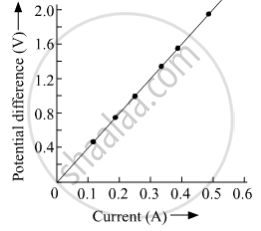
A V-I graph for a nichrome wire is given below. What do you infer from this graph? Draw a labelled circuit diagram to obtain such a graph.
State Ohm’s law.
