Advertisements
Advertisements
Question
Advertisements
Solution
APPEARS IN
RELATED QUESTIONS
What is meant by saying that the potential difference between two points is 1 V?
How much energy is transferred by a 12 V Power supply to each coulomb of charge which it moves around a circuit?
The other name of potential difference is:
Calculate the power used in the 2 Ω resistor in each of the following circuits: a 4 V battery in parallel with 12 Ω and 2 Ω resistors.
How is the electric potential difference between the two points defined? State its S.I. unit.
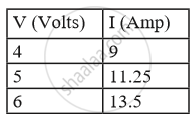
The following table shows current in Amperes and potential difference in Volts.
What will be the nature of the graph between the current and potential difference? (Do not draw a graph.)
The voltage across a 3Ω resistance is 6 V. How large is the current? What is
the resistance of a filament lamp when a voltage of 3 V across it causes a
current of 0.5 A?
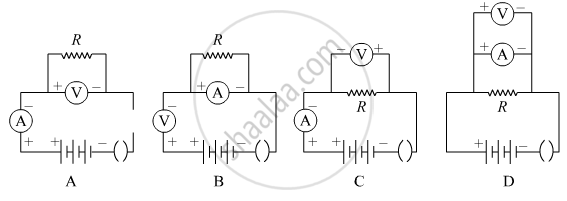
Which one of the following is the correct set-up for studying the dependence of the current on the potential difference across a resistor and why?
Suppose there are three resistors A, B, and C having resistances r1, r2, and r3 respectively. If R represents their equivalent resistance, establish the following relation R = r1 + r2 + r3 when joined in series.
Find out the following in the electric circuit given in Figure
- Effective resistance of two 8 Ω resistors in the combination
- Current flowing through 4 Ω resistor
- Potential difference across 4 Ω resistance
- Power dissipated in 4 Ω resistor
- Difference in ammeter readings, if any.

