Advertisements
Advertisements
Question
A 10 m long wire of a particular material is of resistance 5Ω What will be the resistance if the wire is stretched to double its length?
Advertisements
Solution
On stretching the wire to double its length, the length is doubled and its area of cross-section is reduced to half. So the resistance becomes four times i.e. the resistance of wire will become: 4 × 5Ω = 20 Ω.
RELATED QUESTIONS
State two causes of energy loss in a transformer.
The values of current (I) flowing through a given resistor of resistance (R), for the corresponding values of potential difference (V) across the resistor are as given below:
| V (volts) | 0.5 | 1.0 | 1.5 | 2.0 | 2.5 | 3.0 | 4.0 | 5.0 |
| I (amperes) | 0.1 | 0.2 | 0.3 | 0.4 | 0.5 | 0.6 | 0.8 | 1.0 |
Plot a graph between current (I) and potential difference (V) and determine the resistance (R) of the resistor.
What is the unit of electric charge?
A potential difference of 20 volts is applied across the ends of a resistance of 5 ohms. What current will flow in the resistance?
Write proper word from the following group of words in the blank.
(magnetism, 4.5V, 3.0V, gravitational attraction, potential difference, potential, higher, lower, 0V)
Water in the waterfall flows from a higher level to the lower level because of ______.
Explain why potential difference is always less than the e.m.f. of a cell?
Five resistors of different resistances are connected together as shown in the figure. A 12 V battery is connected to the arrangement.
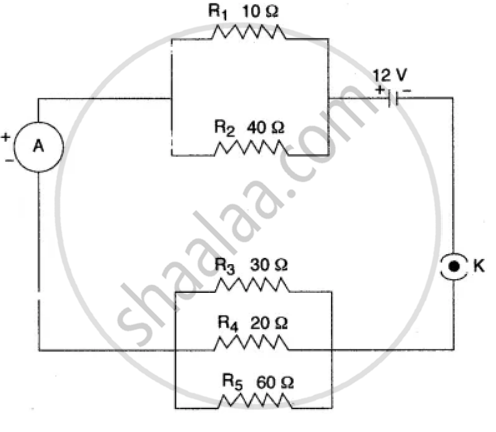
Calculate:
(i) the total resistance in the circuit
(ii) the total current flowing in the circuit.
If P and V are the power and potential of device, the power consumed with a supply potential V1 is:
Name the instrument which is used to measure the potential difference.
Define Electric potential.
