Advertisements
Advertisements
प्रश्न
A 10 m long wire of a particular material is of resistance 5Ω What will be the resistance if the wire is stretched to double its length?
Advertisements
उत्तर
On stretching the wire to double its length, the length is doubled and its area of cross-section is reduced to half. So the resistance becomes four times i.e. the resistance of wire will become: 4 × 5Ω = 20 Ω.
संबंधित प्रश्न
The p.d. across a lamp is 12 V. How many joules of electrical energy are changed into heat and light when: a current of 2 A flows through it for 10 s?
Name the law which relates the current in a conductor to the potential difference across its ends.
A resistance of 20 ohms has a current of 2 amperes flowing in it. What potential difference is there between its ends?
Why do electricians wear rubber hand gloves while working with electricity?
Explain the statement ‘the potential difference between two points is 1 volt’.
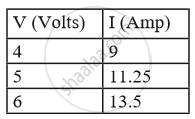
The following table shows current in Amperes and potential difference in Volts.
Which law will the graph prove? Explain the law.
Three electric cells of potential difference 1.5 V each have been connected as a battery. The potential differences of the battery will be ____________ V.
Draw a graph of Potential difference (V) versus Current (I) for an ohmic resistor. How can you find the resistance of the resistor from this graph?
A cell of e.m.f 2.0 V and internal resistance 1Ω is connected to the resistors of 3Ω and 6Ω in series. Calculate:
(i) the current drawn from the cell,
(ii) the p.d. across each resistor,
(iii) the terminal voltage of the cell and
(iv) the voltage drop.
A 10 m long wire of a particular material is of reistance 5Ω What will be the resistance of 5m long wire of same material and the same thickness.
